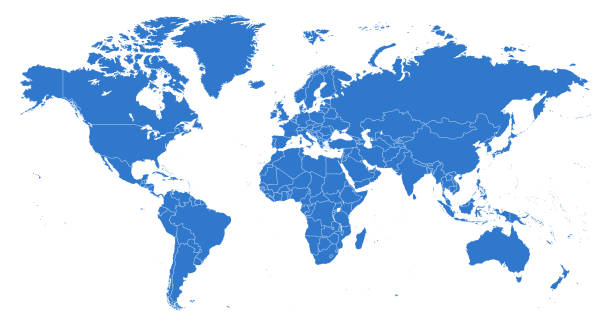
The names of countries is a topic that I have been fascinated with for the past few weeks. From just looking at the names, we can learn so much about the history of these countries and their relations with other nations.
Here are some of my favourite examples that I have learned about.
Canada

Let’s start with my home, Canada.
This one is pretty simple! It came from the Iroquoian word “Kanata”, meaning “village” or “settlement”. French explorer Jacque Cartier misinterpreted the word in 1535 and decided to use the word “Canada” for the French colony around the St. Lawrence River. The name has been kept ever since.
Canada in different languages are just the same as its English name adapted into local sounds.
Russian: Канада (Kanada)
Chinese: 加拿大 (Jiānádà / Ga-naa-dai in Cantonese)
Japanese: カナダ (Kanada)
Korean: 캐나다 (Kaenada)
Arabic: كندا (Kanadā)
Japan (日本 – Nihon / Nippon)
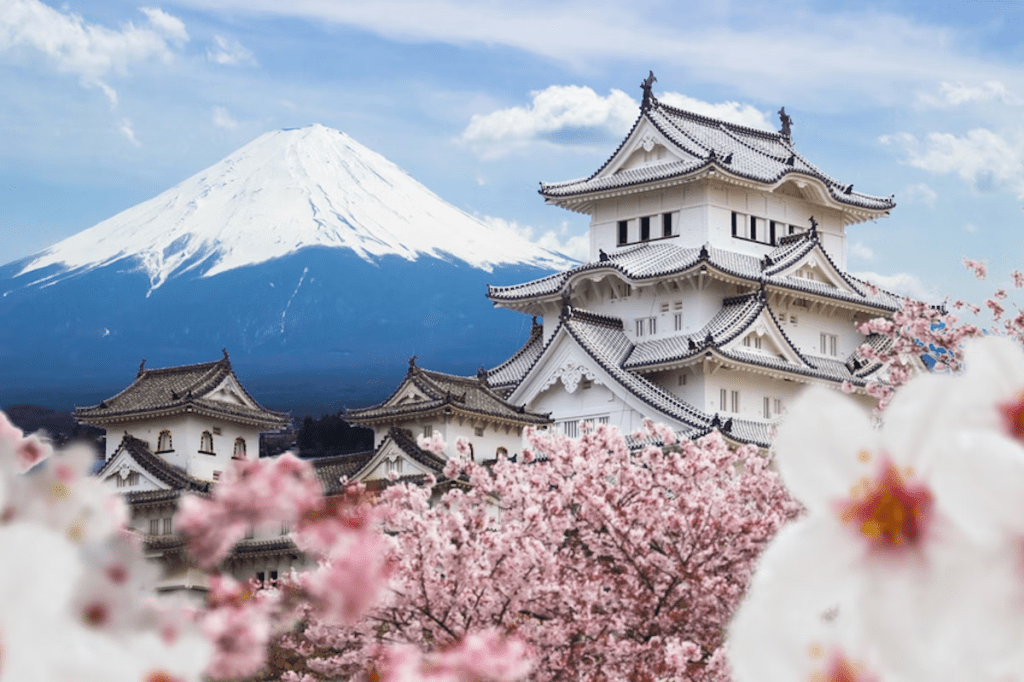
Japan, the land of rising sun, has rather consistent names around the world.
English: Japan
Japanese: 日本 (Nihon or Nippon)
French: Japon
Spanish: Japón
German: Japan
Chinese: 日本 (Rìběn)
Russian: Япония (Yaponiya)
Arabic: اليابان (Al-Yābān)
Japan’s modern-day name, “Nihon” (日本), means “origin of the sun”, because Japan lies to the east of China—the direction from which the sun rises. The earliest recorded appearance of this name is found in the Old Book of Tang (Jiù Tángshū – 旧唐书), which mentions Japanese envoys requesting a change to the name of their land.
At the time, China was the central economic and cultural power of East Asia and held the authority to bestow names upon foreign states. In the year 703, it granted Japan the name 日本 (Nihon). Prior to this, Japan referred to itself as “Yamato” (大和), meaning “Great Peace.”
The origin of the Western name “Japan” can be traced back to the 13th century, when Marco Polo visited China and learned of the island nation through the name “Cipangu”—a then-Chinese transliteration of 日本国 (Rìběnguó), meaning “country of the sun’s origin.”
By 1577, the earliest recorded English usage of “Giapan” had appeared.
In the 16th century, Portuguese traders heard various pronunciations of the name—such as Jepang, Jipang, and Jepun—from Malay and Indonesian sources.
Germany / Deustchland
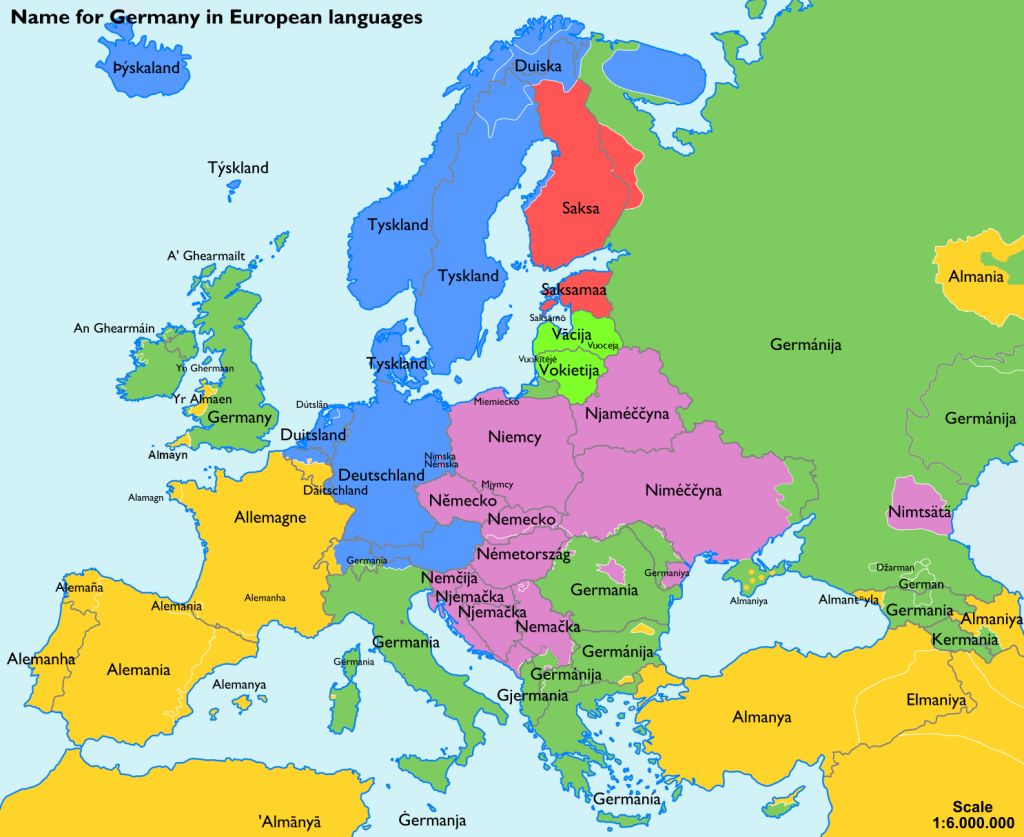
Located in the heart of Western Europe, Germany is a fascinating case study in how wildly different country names can emerge from historical, cultural, and linguistic encounters.
As we continue to explore the world, we find that historically significant nations often have multiple names, each reflecting the unique perspective of the people who named them.
The names for Germany generally fall into five major categories:
- Deutschland
- Used in: German, Dutch, and similar languages
- Origin: From Old High German diutisc land, meaning “land of the people (who speak our language)”
- This is a name based on linguistic identity.
- Niemcy
- Used in: Polish and other Slavic languages (e.g., Russian Nemtsy)
- Origin: From a Slavic root meaning “mute” or “unable to speak (our language)”
- A reflection of the language barrier experienced by early Slavs encountering Germanic peoples.
- Germany
- Used in: English, Italian, Russian, and others
- Origin: From Latin Germania, used by the Romans to describe the lands beyond the Rhine River (modern southwestern Germany)
- This name reflects the Roman worldview and their frontier concept of “Germans.”
- Allemagne
- Used in: French, Spanish (Alemania), Arabic (Almāniyā), and others
- Origin: From the Alemanni, a confederation of Germanic tribes in what is now southwestern Germany and Alsace
- This term reveals the tribal identity that early Latin Europe associated with the region.
- Saksa
- Used in: Finnish and Estonian
- Origin: From the Saxons, a major Germanic tribe
- This highlights the northern European contact point, particularly via trade routes and the Hanseatic League.
These five categories offer a vivid map of how different peoples—Romans, Slavs, French, Finns, and others—first encountered the Germanic civilizations.
Greece
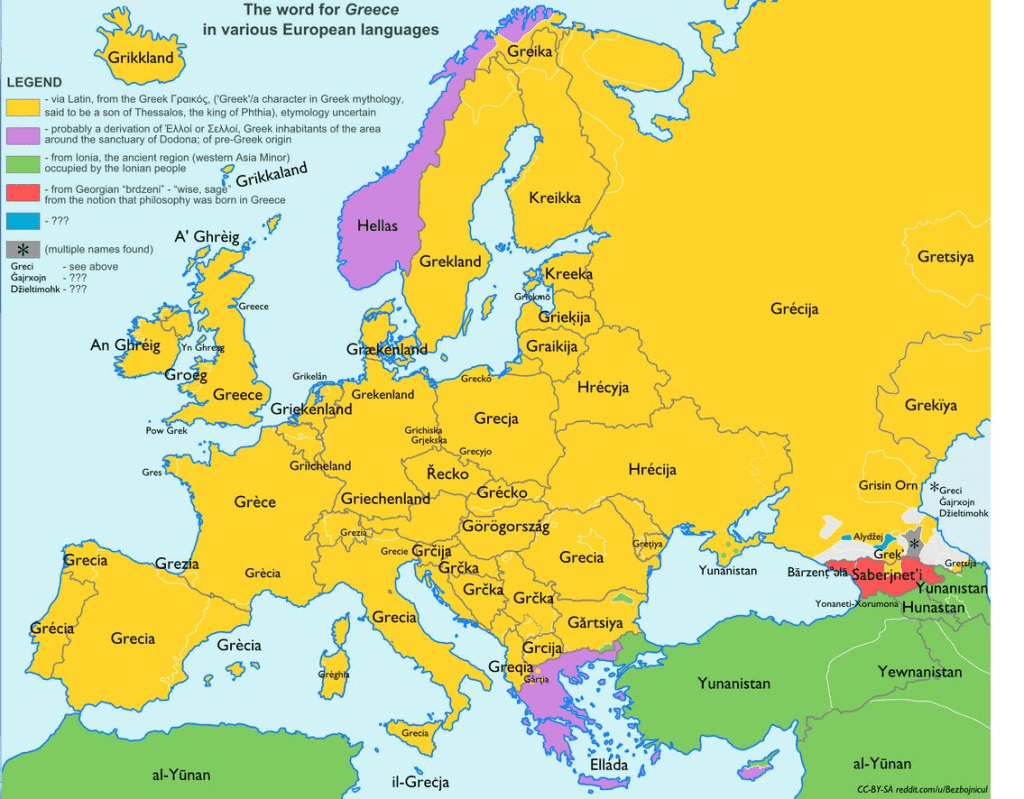
Greece is one of my favourite examples of this with a few major names:
- Hellas: (Ελλάδα – Elláda / Hellada ). This is the name Greeks use to refer to their own country in the Greek language. They refer to themselves as Hellenes (Έλληνες – Éllines). This comes from their shared ancestral and cultural identity with the legendary patriarch Hellen (not to be confused with Helen of Troy).
- The four major tribes—Dorians, Ionians, Aeolians, and Achaeans—made up the Hellenes.
- The Hellenistic Period (323 BCE – 31 BCE) marked the peak of Greek cultural influence around the Mediterranean Sea. The modern-day “Greece” is officially known as the Hellenic Republic. This name carries the same cultural and historical pride as the term “Persians” for Iranians and “Han” for Chinese
- I personally prefer “Hellas” and “Hellens” over “Greece” and “Greek.”
- Greece / Grèce and all of its variations: Used across nearly the entire European continent north of Greece, extending as far as Russia. It comes from the Latin word Graecia, referring to an ancient Greek tribe, the Graeci, who likely made the first contact with the Western world.
- Yunan and all of its variations: This name comes from the ancient Greek tribe of the Ionians. It is used throughout Persian-influenced regions that use the suffix -stan (meaning “land of”) or the prefix al- (meaning “the”) in Arabic.
- Used in: Arabic, Persian, Turkish, Urdu, Hindi, and other South Asian languages
Norway and Sweden both used to refer to Greece as Grekenland (“Land of the Greeks”).
However, after Norway’s independence from Sweden, there was a movement to reform the Norwegian dictionary to better reflect local endonyms (native names).
As a result, Norway became the only country north of Greece to officially use the name Hellas.
It’s an unrealistic dream but, more countries should do this.
While Japan, Korea, and Thailand use European-based transliterations of “Greece,” likely adopted through Portuguese, Dutch, English, or French:
- Japanese: ギリシャ (Girisha)
- Korean: 그리스 (Geuriseu)
- Thai: กรีซ (Krít)
China and Vietnam, however, use names that more closely resemble “Hellas”:
- Vietnamese: Hy Lạp
- Chinese: 希腊 (Xīlà)
India
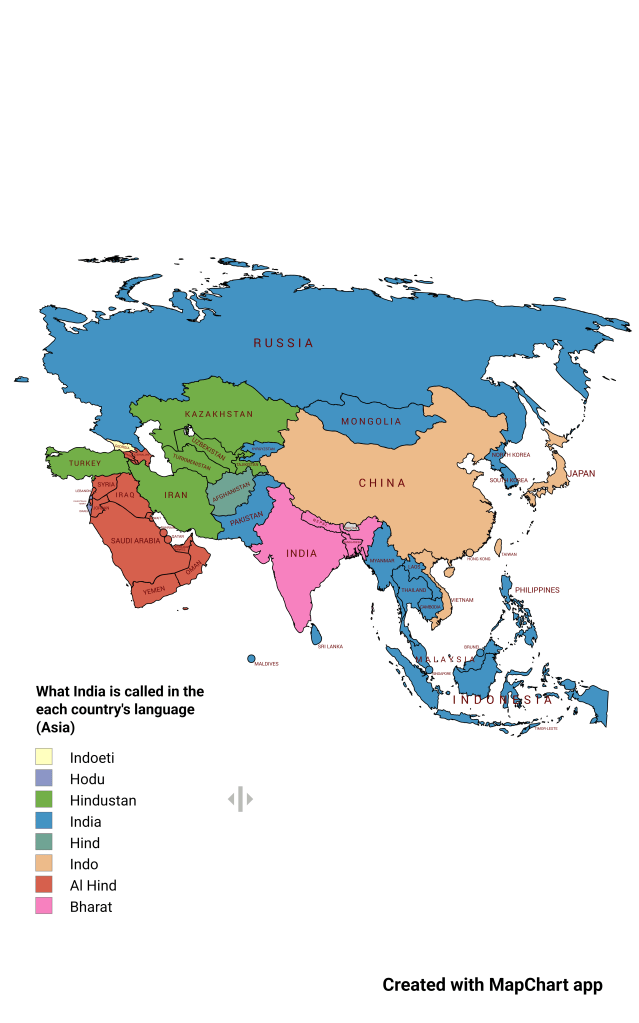
The Indus Valley civilization is one of the ancient civilizations of the world, alongside Greece, Egypt, China, and Mesopotamia. The name “Indus” heavily influenced the various names for India used by much of the world. The Sanskrit word for “river,” “Sindhu” (सिन्धु), is the basis for all things “Indian.”
- India: Used in English, all Latin-based languages, and East Asian languages such as Chinese, Korean, and Japanese. It traces from Sindhu / Indus River → Latin India → Greek India → English India. The word itself has remained mostly unchanged in the Western world. The Indian constitution also refers to the nation legally as India.
- Bhārat (भारत): This is used in Hindi and Sanskrit. It stemmed from Bharata, a legendary king mentioned in the Mahabharata. It is culturally significant name used widely by Hindi speaking Indians.
- Hind / Hindustan (هندوستان): Used in Persian, Arabic, and Urdu, this name also derives from the term Sindhu, referring to the Indus River.
- Āryāvarta (आर्यावर्त): From Vedic Sanskrit, meaning “Land of the Aryans”. It was used during the Vedic period (c. 1500–500 BCE) to refer to Northern India.
The term “Aryan” has been widely misused, especially by white Europeans. It originally referred to people who spoke the Indo-Iranian languages. However, Nazi ideology distorted it to mean people of white Nordic European descent with blond hair and blue eyes—traits uncommon among actual Aryans.
Similarly, “Caucasians” today commonly refers to white people, but the term actually comes from the Caucasus region between Eastern Europe and Central Asia, including modern-day Southern Russia, Georgia, Armenia, and Azerbaijan. This term is a 19th-century European anthropological construct with a highly problematic history. It is outdated and imprecise in academic contexts.
The word “Semites” in modern usage almost exclusively refers to Jewish people, but it actually describes people who speak Semitic languages—such as Arabic, Hebrew, Amharic, and Aramaic. The term comes from Shem, the son of Noah in the Bible, said to be the ancestor of Semitic peoples. Unfortunately, the phrase “anti-Semitism” has popularized the misconception that “Semitism” refers only to the Jewish faith, while linguistically, it refers to a language family.
Korea
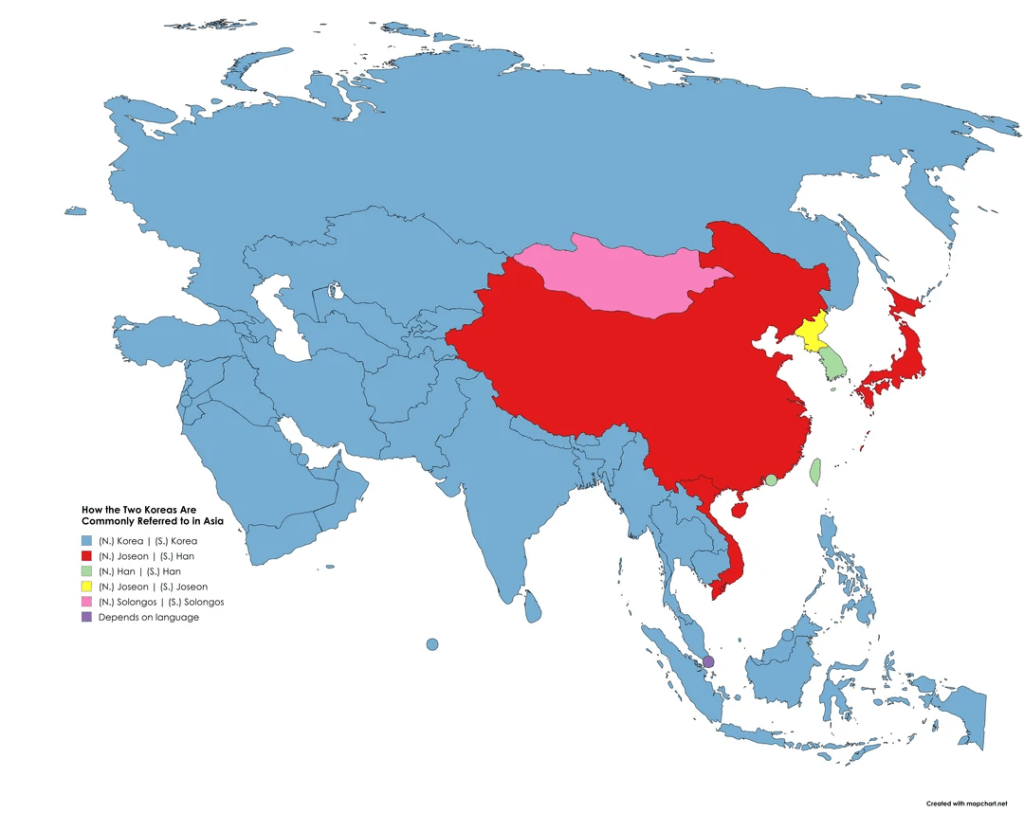
As far as Asian countries go, Korea (both north and south) has one of the most interesting names in foreign languages.
- Korea: This is the name used in English, French, German, Arabic, Hindi, Persian, and many other languages. It comes from Goryeo (고려; 高麗; Koryŏ), a culturally significant period in the Korean Peninsula (918–1392).
- Goryeo was established after the unification of the Three Kingdoms of Goguryeo, Baekje, and Silla. It became the single political entity that laid the foundation of modern Korean identity, in a manner similar to how the Han or Tang dynasties shaped China’s identity.
- During this period, Korea made contact with foreign nations, and the name “Goryeo” was captured and transmitted internationally. The name “Korea” and all of its linguistic variations continue to be used today, even though neither North Korea nor South Korea refers to itself as such in their native languages.It starts to get real interesting when we start discussing the names Asian countries use for DPRK (North Korea) and ROK (South Korea), split between the next two names.
- Chosun (조선 / 朝鮮): This name comes from the dynastic kingdom of Joseon, which lasted for 505 years, from 1392 (after the end of Goryeo) to 1897. Much of modern-day Korean culture can be traced back to this era. It is the name most commonly associated with the modern-day DPRK (North Korea).
- Hanguk (한국 / 韓國): The identity of Hanguk (literally, “Nation of Han”) was adopted in 1897 (after the Chosun era) as a reference to the Samhan, the “Three Han Kingdoms” in Korean history. The official name Daehan Jeguk (대한제국; 大韓帝國) means “The Empire of the Great Han.” It was a culturally nationalistic title declaring independence, as an empire cannot be subordinate to another country. Although Daehan Jeguk is no longer in use, Hanguk is most commonly associated with modern-day ROK (South Korea).
The history and names of Korea are highly complicated. Although present-day Korea is divided into the Democratic People’s Republic of Korea (North Korea) and the Republic of Korea (South Korea), its history is deeply complex. It has gone through several names—Goryeo, Chosun/Joseon, and Hanguk—and as a result, different countries use different names for the two Koreas as well as for the Korean Peninsula as a whole.
The names of Korea, in order:
- Three Kindoms
- Goryeo
- Chosun / Joseon
- Han
- back to Joseon during Japanese colonial period
- Korean peninsula split (Korean War)
- Han (in the South)
- Chosun (in the North)
Whew, that was a lot of information. Let’s finally take a look at the names of the two modern day Koreas.
- The DPRK (North Korea) refers to itself as Chosŏn Minjujuŭi Inmin Konghwaguk (조선민주주의인민공화국; 朝鮮民主主義人民共和國). The English name, “Democratic People’s Republic of Korea,” is a direct translation of its Korean name, which retains the “Chosun” identity. For Korea as a whole, the DPRK also uses “Chosun.”
- The DPRK refers to South Korea as “Namjosun” (남조선; 南朝鮮), meaning “South Chosun”.
- The ROK (South Korea) refers to itself as Daehanminguk (대한민국; 大韓民國). The English name, “Republic of Korea,” doesn’t fully capture the meaning of its Korean name. From its Hanja characters, it more accurately means “The Republic of Great Korea.”
- South Korea refers to North Korea as Bukhan (북한; 北韓), meaning “North Han,” and itself as Namhan (남한; 南韓), meaning “South Han.”
- Naming difference between North and South Korea:
- The two countries have opted for different names to refer to the Korean identity, themselves, and each other.
- The official designated meeting area between the Koreas are called Namcheuk (남측, 南側) and Bukcheuk (북측, 北側), meaning “the South Side” and “the North Side”.
- The “Han” vs. “Chosun” difference also extends to the names of their language and region.
- In the North, they call the spoken language, written language, and the peninsula: Chosŏnŏ (조선어, 朝鮮語), Chosŏn’gŭl (조선글), and Chosŏn Bando (조선반도, 朝鮮半島).
- In the South, they say: Hangugeo (한국어, 韓國語), hangeul (한글), and Hanbando (한반도, 韓半島).
- China: After establishing diplomatic relations with both Koreas, mainland China uses the preferred term for each country. It uses “Cháoxiǎn” (朝鲜) for all things related to North Korea and “Hán” (韩 / 韓國) for all things related to South Korea, such as people (Cháoxiǎn Rén / Hán Guó Rén), language (Cháoxiǎn Yǔ / Hán Guó Yǔ), and food (Cháoxiǎn Cài / Hán Guó Cài).
- Specifically when referring to the Korean Peninsula and the Korean War, the term “Cháoxiǎn” (朝鲜) is still used.
- Unofficially, Běi Hán (北韩), meaning “North Han,” is used in informal settings to refer to North Korea, but Nán Cháoxiǎn (南朝鲜), meaning “South Chosun,” is never used for South Korea.
- Taiwan: Since Taiwan has no diplomatic relationship with North Korea, it uses “Han” when referring to both Koreas — Běi Hán (北韩) for North Korea and Nán Hán (南韩) for South Korea. The term “Cháoxiǎn” / “Chosun” (朝鲜) is generally limited to references to ancient Korea.
- Hong Kong / Macau: Traditionally, Hong Kong and Macau used Bak Hon (北韓) for North Korea and Nam Hon (南韓) for South Korea. However, under the influence of the People’s Republic of China’s government, the term “Chosun” (朝鮮) is gradually seeing more usage.
- Singapore / Malaysia: The Chinese-speaking diaspora in Singapore and Malaysia generally follow the naming conventions of Mainland China—using “Cháoxiǎn” (朝鲜) for North Korea and “Hán Guó” (韩国) for South Korea.
- An example of an exception to the rule is Korean-derived words such as Korean ginseng, which is named Gaoli Shēn (高麗參), meaning “Goryeo ginseng.”
- Japan: Japan follows the naming scheme according to each Korea’s preferred name—using the Japanese Kanji readings of “Chōsen” (朝鮮) for Chosun and “Kan” (韓) for Han.
- North Korea is called Kita-Chōsen (北朝鮮), meaning “North Chosun,” and South Korea is called Kankoku (韓国), meaning “Hanguk.”
- For Korea as a whole and the Korean Peninsula, Japan still uses the term “Chōsen” (朝鮮).
- For the Korean language, the terms Kankokugo (韓国語) and Chōsengo (朝鮮語) are used for the languages of South Korea and North Korea, respectively, while academia generally prefers Chōsengo (朝鮮語).
- Due to the politicization of the terms Chōsen and Kankoku, the term Koria (コリア)—a phonetic transliteration of the English word “Korea”—is sometimes used to refer to the Korean ethnicity and shared language.
- North Korea is called Kita-Chōsen (北朝鮮), meaning “North Chosun,” and South Korea is called Kankoku (韓国), meaning “Hanguk.”
- Vietnam: Before the reunification of North and South Vietnam, Northern Vietnamese used Bắc Triều Tiên (北朝鮮; Bukchosŏn) and Nam Triều Tiên (南朝鮮; Namjoseon) for North and South Korea, respectively, while Southern Vietnamese used Bắc Hàn (北韓; Bukhan) and Nam Hàn (南韓; Namhan).
- After reunification, South Korea requested that Vietnam adopt the names it uses for itself. As a result, Triều Tiên (朝鮮; “Chosŏn”) and Hàn Quốc (韓國; “Hanguk”) became the current names Vietnam uses for North Korea and South Korea.
China
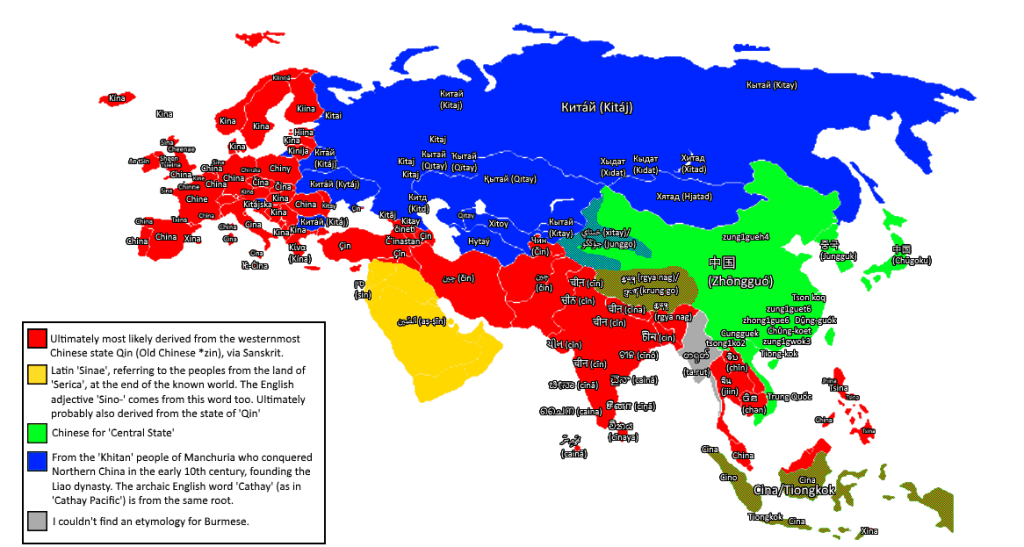
The majority of China’s names can be grouped into two categories: variations derived from “Qin” (秦, Qín) — the Qin Dynasty — and variations of “Zhongguo” (中国 / 中國, Zhōngguó), the name China uses for itself, meaning “Central Country” or “Middle Kingdom.”
- China and all of its variations: came from the name “Qin” (秦, Qín), a 2,200-year-old name dating back to when China was first unified under the Qin Dynasty.
- This name is used in many languages, such as Arabic (Al-Sīn, الصين), Hindi (Cin), Persian (Chin), French (Chine), Italian (Cina), and others. All these languages, which initially made contact with the Qin Empire via the Silk Road, have retained this name ever since.
- In Latin, the names for China are Sinae and Serica. Sinae derives from Qin and later evolved into terms like “Sina” and “Sino,” which are used to describe things related to China, such as the “Sino-Japanese War.” Meanwhile, Serica was another Greco-Roman name meaning “Land of Silk.”
- Zhōngguó (中国) is the modern name for China in all Chinese languages. However, the history of this name traces back to the 11th century BCE during the Western Zhou period. Initially, it referred specifically to the Yellow River Valley, but over time its meaning evolved and its usage expanded, eventually coming to mean “Middle Kingdom.” This name symbolizes Imperial China’s sense of cultural centrality and arrogance, as it regarded itself as the center of the world.
- The modern-day People’s Republic of China’s Chinese name, Zhōnghuá Rénmín Gònghéguó (中华人民共和国), was deliberately chosen so it could be shortened to Zhōngguó (中国). Similarly, its predecessor government and the current government of Taiwan, the Republic of China — Zhōnghuá Mínguó (中華民國) — can also be shortened to Zhōngguó (中國).
- Both the PRC and ROC’s English names contain the word “China,” and their Chinese names can both be shortened to Zhōngguó (中国 / 中國). This contrasts with the distinct identities of North and South Korea, which use the names Chosun and Hanguk, respectively.
- Kitay / Khyatad: Used in Russian and Mongolian, these names come from Khitan, a steppe empire in northern China that likely made the first contact.
Chinese names for other countries
China’s names for other countries generally follow the phonetic readings of their native names, such as Bōlán (波兰) for Poland, Ài’ěrlán (爱尔兰) for Ireland, and Nuówēi (挪威) for Norway. For countries in the Sinosphere (culturally influenced by ancient China), the Chinese readings of their names are used, such as Rìběn (日本) for Japan, Hánguó (韩国) for South Korea, Cháoxiǎn (朝鲜) for North Korea, and Yuènán (越南) for Vietnam.
However, there are four countries that have unique names. These names use specific characters that are tied to specific virtues or cultural traits but also retain their phonetic sounds.
- Germany: Dé Guó (德国) – The “De” sound matches “Deutsch”. The name means “Virtue Country“, likely refers to the German nobles or the disciplined image China had for Germany.
- USA: Měi Guó (美国) – The “Mei” sound matches “AMerica”. The name means “Beautiful Country“. Unsure if this was chosen to refer to the people or the landscape.
- France: Fǎ Guó (法国) – The “Fa” sound matches “France”. The name means “Law Country”. While France is known for its legal tradition such as the Napoleonic Code, this name was a pure coincidence.
- England: Yīng Guó (英国) – The “Ying” sound matches “England”. The name means “Heroic Country”, likely refers to the heroic knighthood culture of England.
These names arose in the 19th century, when Chinese scholars wanted to standardized the names for foreign countries, and these countries (perhaps the most diplomatically important at the time) received special names with special meanings.
Afterword
History, geography and etymology are all fascinating topics to me. The different names of countries in other languages say so much about the history between the two countries.
Ultimately, the name of a state, country, or nation is both cultural and political. It needs to be a unifying force for its people and accurately represent their identity.
This world is an endless trove full of these exciting historical tales. Hopefully this post can inspire you to learn more about your own or other countries names and where they came from!
 David's Blog
Leave a comment