Introduction
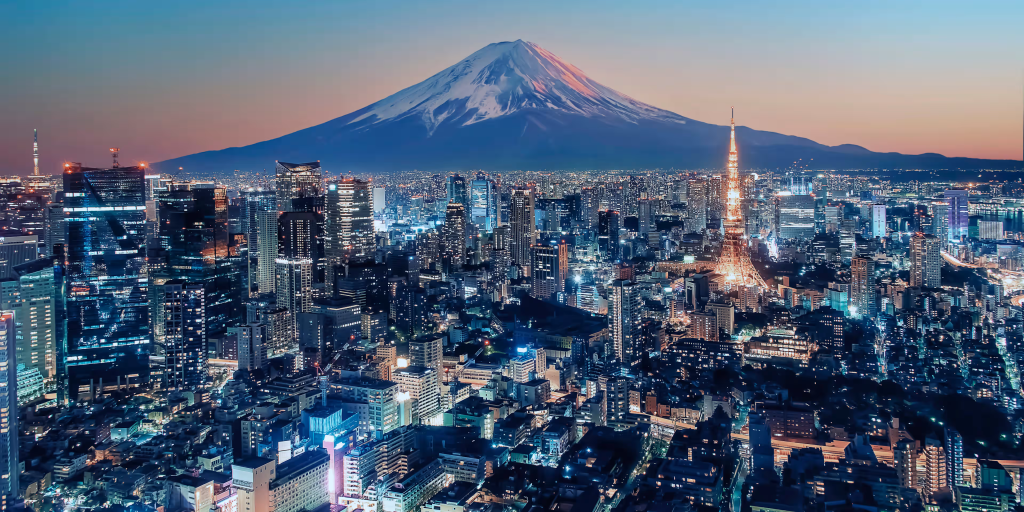
Tokyo, the cyberpunk city of Eastern Japan. A name that people from all over the world recognize immediately. It went by the name of “Edo” until the Meiji Restoration (1868 September 3rd) rebranded it with the name we still use today—Tokyo (東京), meaning “Eastern Capital,” in contrast to the western capital city of Kyoto. The history of Tokyo is long and interesting, with governmental and imperial power constantly in flux throughout Japanese history. But this post is focused on the Tokyo of today—my own perception, research, and experience.
What is Tokyo, really?
For starters, I’m going to contradict the first sentence of this post.
Tokyo is not a city.
Cities in Japan use the suffix “-shi” (市) to indicate that they are cities by the internationally recognized standard—having national official designation, clear boundaries, local municipal governance (mayor, city council, city hall, etc.), urban infrastructure, etc.
By looking at the suffix, you can tell what level of administrative region a place in Japan falls under. A “prefecture” (similar to a province, but with less autonomy and self-governance) can be one of the following: to (都), dō (道), fu (府), and ken (県).
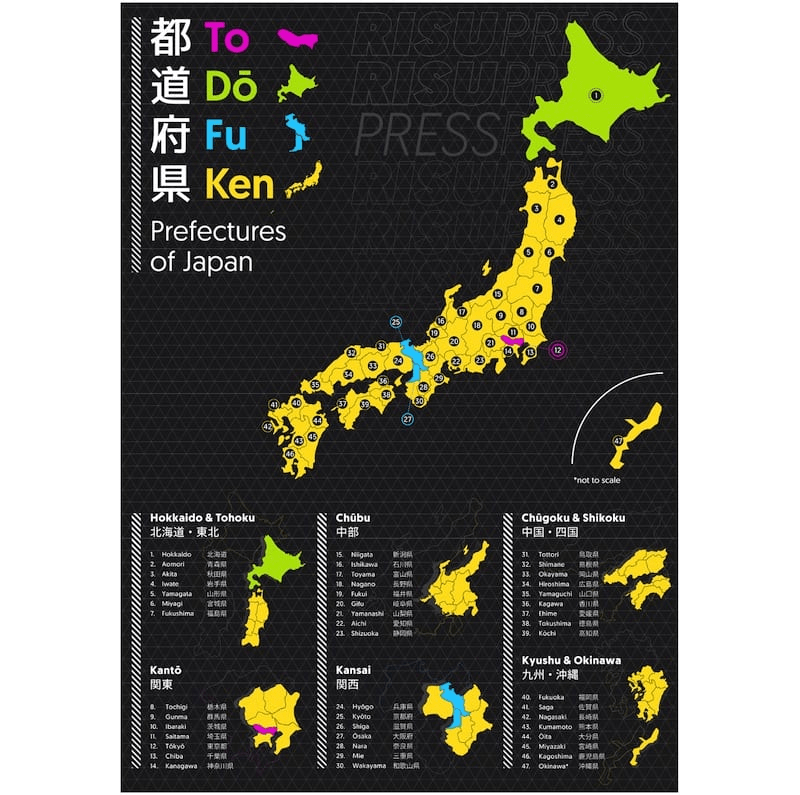
The “ken” (県) is the most commonly used prefectural suffix in Japan. Examples are Kanagawa-ken, Fukuoka-ken, and Okinawa-ken. There are 43 “ken” across Japan.
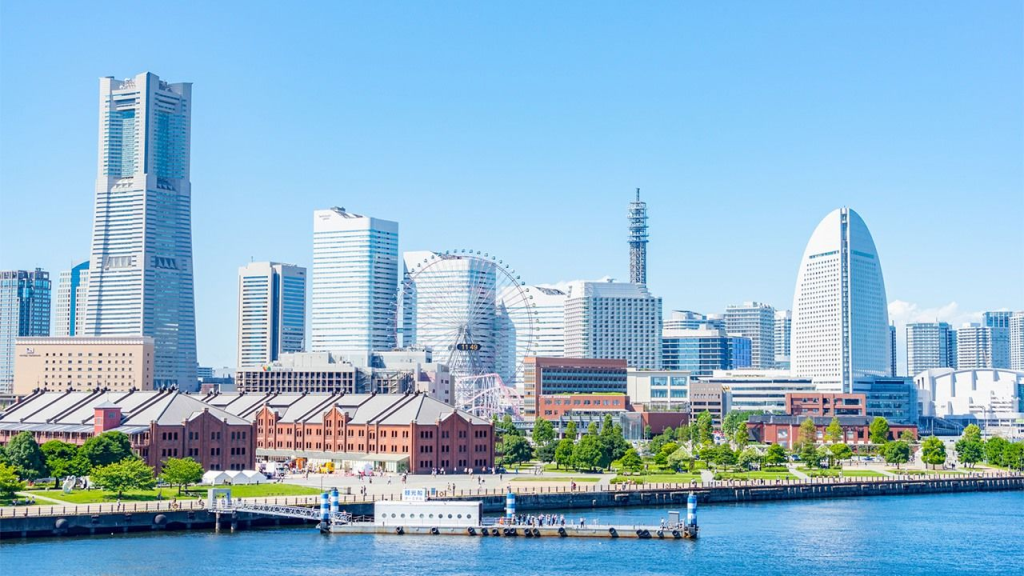
“Dō” (道) is used exclusively for “Hokkaidō” (Northern Sea Circuit). It is functionally identical to a “ken,” but the name is kept due to historical reasons. There also used to be a “Tōkaidō” (東海道 – Eastern Sea Circuit) and “Nakasendō” (中山道 – Middle Mountain Circuit), but they were used only for the circuits and never developed into prefectural-level administrative regions like Hokkaido.
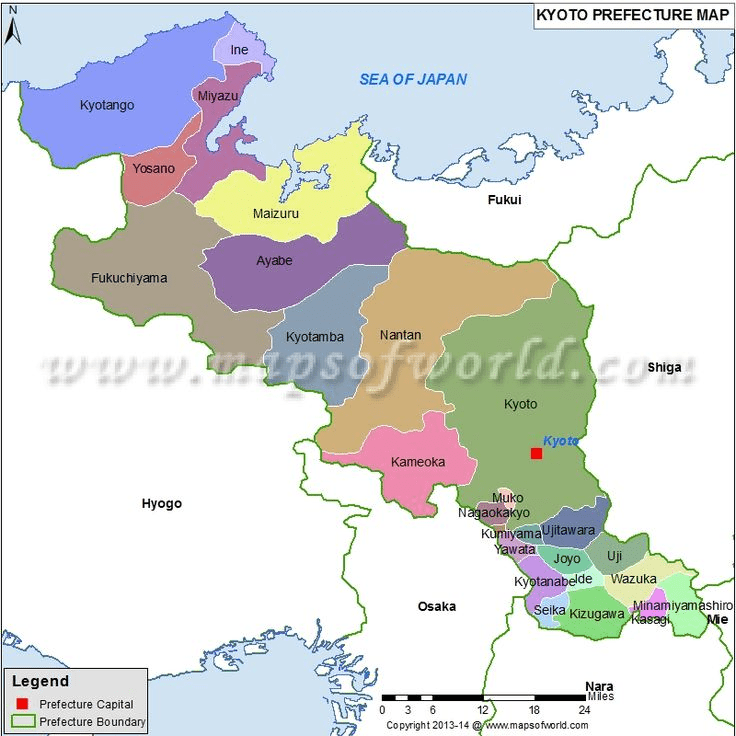
There are two “fu” (府) in Japan—Kyōto-fu and Ōsaka-fu. Historically speaking, they are politically and economically significant and therefore have the title of “fu” (functionally still identical to “ken”). Their capital cities also use the same name—Kyōto-shi (Kyōto City) and Ōsaka-shi (Ōsaka City). This trend of the largest city in a prefecture having the same name as the prefecture is a common one across Japan. So, when Japanese people talk about “Kyōto,” they will often specify which Kyōto they are referring to—the prefecture or the city, but adding the prefix of “-fu” or “-shi”. This is similar to the New York City and New York State distinction.
Tōkyō is none of the above. It is a “to” (都), a title for the prefectural-level capital “metropolitan area” of Japan. Prior to 1943, the present-day Tōkyō-to consisted of Tōkyō-fu (Tōkyō Prefecture) and Tōkyō-shi (Tōkyō City). “Tōkyō-shi” is a term no longer in use in Japan, but the name “Tōkyō City” from back then has more or less stuck around in English-speaking countries.
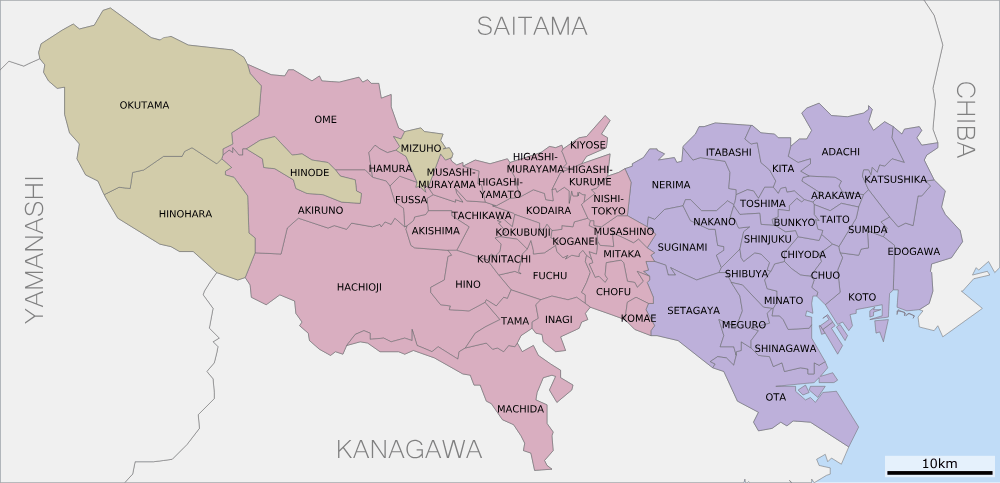
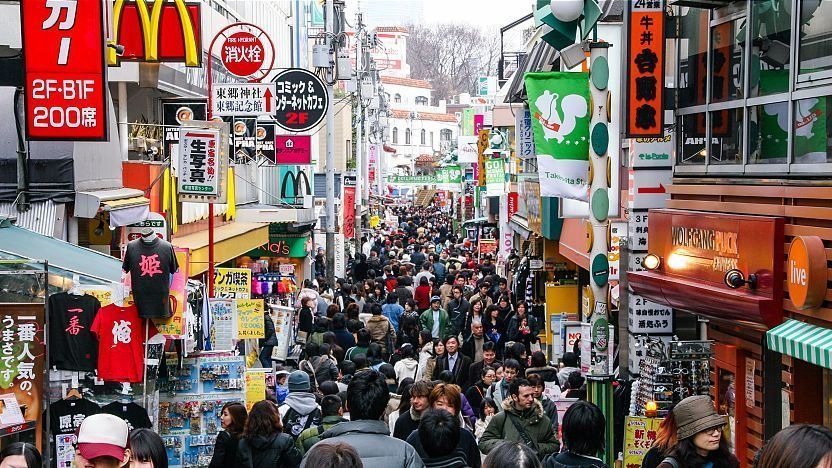
Today, Tōkyō-to (東京都) consists of the 23 special wards (ku – 東京23区) that made up the old “Tōkyō-shi,” 26 cities, 1 district, and 4 subprefectures. However, when people talk about “Tōkyō” or “Tōkyō City,” they are most likely referring to the 23 special wards (Shibuya-ku, Shinjuku-ku, Setagaya-ku, etc.) that has the highest concentration of people and economic activities.
Interestingly, the official English names of these special wards follow the “City” naming scheme (Shibuya City, Shinjuku City, Setagaya City, etc.). These special wards all have their own mayors, city halls, taxation policies, garbage disposal systems, etc.
Tokyo-to’s lesser known regions
The Tokyo Metropolitan Area has natural features that people don’t normally associate with the concept of “Tokyo”.
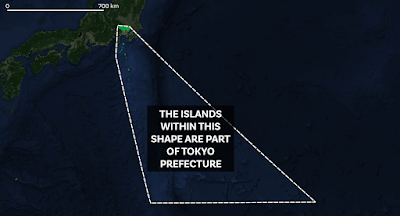
- Islands: Tokyo-to governs the island chains of Izu and Ogasawara. They are, respectively, 200km and 1000km from the mainland.
- Mountains: A third of Tokyo-to is mountainous and forest areas. Notable mountains are Mt. Mitake, Mt. Takao, Mt. Kumotori, Mt. Mito.
- Villages and towns: The Tama Region has a few towns that also fall under the Tokyo-to jurisdiction, such as Hinode Town, Okutama Town, and Hinohara Town. However, these towns are closer to the center of Yamanashi prefecture than central Tokyo.
Tokyo-to Population
When discussing the population of Tokyo, many people use the 40 million figure. However, that is a common misconception. That number refers to the Greater Tokyo Area, which includes Tōkyō-to and its surrounding metropolitan prefectures of Kanagawa, Saitama, Chiba, and parts of Ibaraki, Gunma, Tochigi, and Yamanashi (depending on the definition).
There aren’t 40 million people living in the entirety of Tōkyō-to. That would be insane.
These regions are usually grouped together into the Greater Tokyo Area because they are extremely interconnected via cross-prefectural commuter trains, have shared developmental history stemming from Tokyo’s status as the capital, and many of Tokyo’s workers live in the surrounding prefectures. Despite being separate prefectures, the different metropolitan centers of the Greater Tokyo Area have not developed distinctly separate cultural identities. They are only separated as administrative regions.
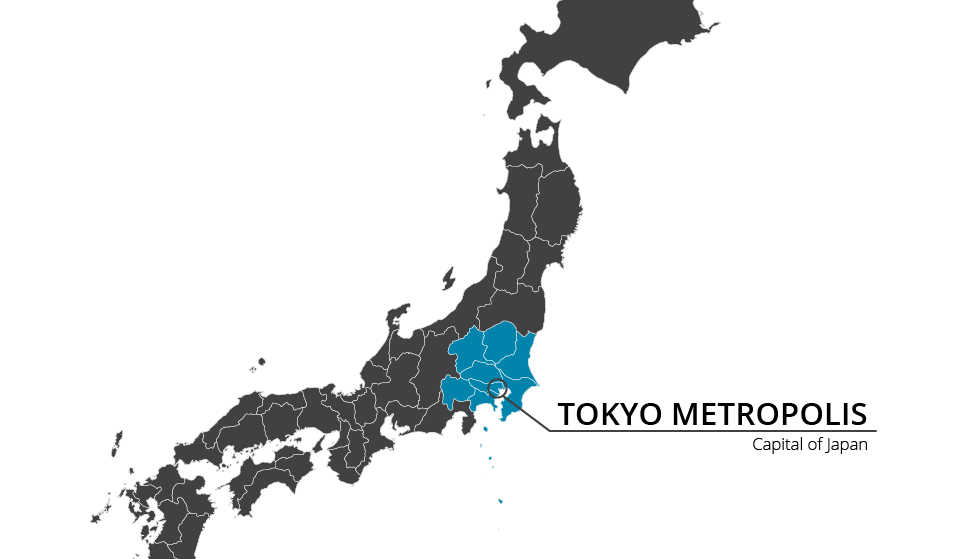
The Greater Tokyo Area has approximately 33% of Japan’s total population (124 million).
The entirety of Tōkyō-to has a population of around 14 million, and the 23 special wards have around 9.7 million. This means that the 23 special wards of Tokyo have a population density of 15,500 people/km². For comparison, Seoul (city proper) has a population density of 16,000, Hong Kong (urbanized area only) has 25,000, and Manhattan has 27,000.
Tōkyō-to has 12% of Japan’s total population.
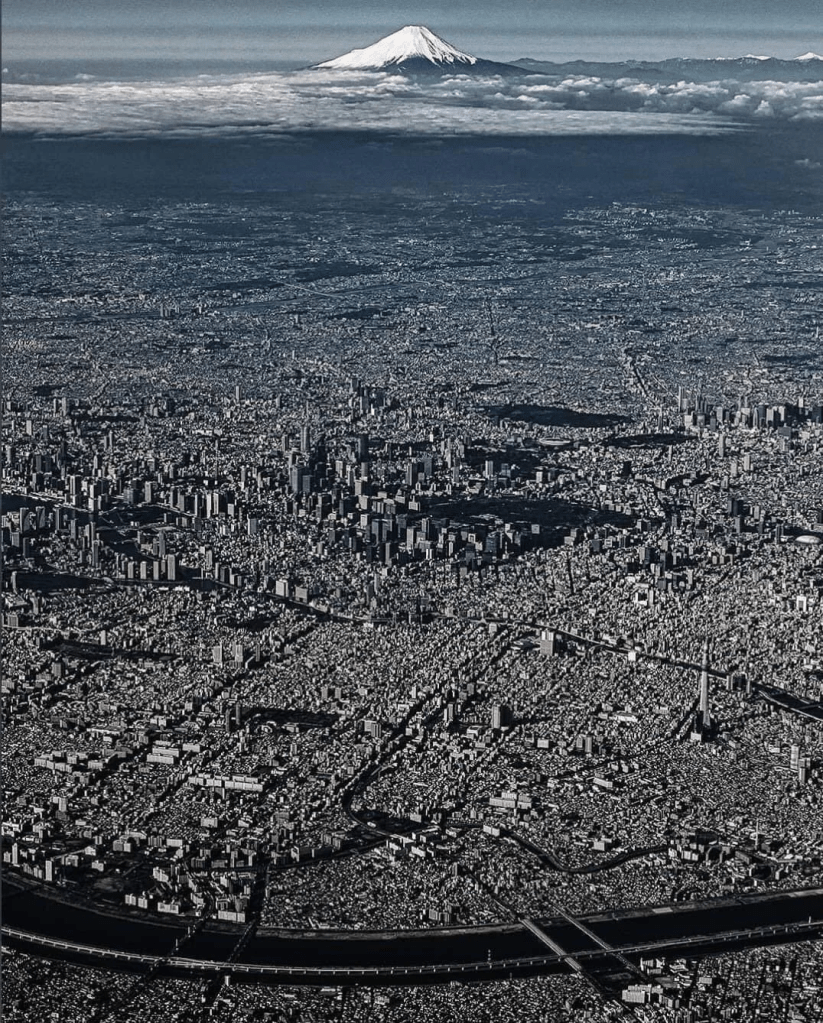
The Good
The list of what makes Tokyo an S tier metropolitan area in the world is endless. I will discuss a few of them below.
Tokyo’s economic output
To no one’s surprise, the Tokyo Metropolitan Area has a monstrous economic output. It has a GRP (gross Regional product: $1.04 trillion USD, which is roughly 20.7% of Japan’s national GDP.
This is roughly equivalent to a medium-sized developed nation like the Netherlands ($1.0 trillion) and Switzerland ($0.9 trillion). The breakdown of its most prominent sectors is as follows:
- Wholesale & retail: 21.5%
- Real estate: 13.5%
- Professional, scientific & technical services: 12.2%
- Information & communications: 11.7%
- Finance & insurance: 7.6%
- Manufacturing: 7%
- Healthcare: 6.7%
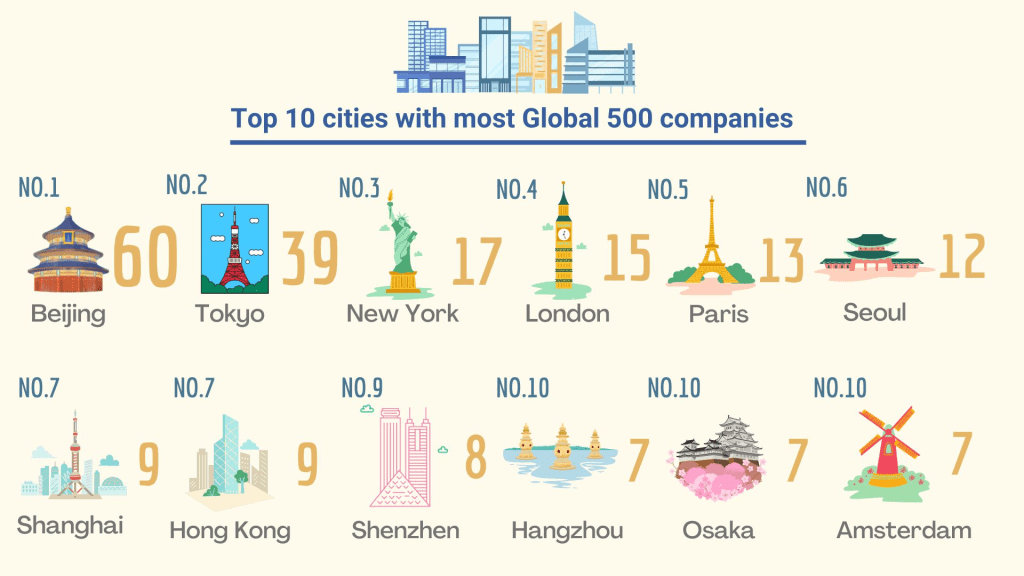
If we take the Greater Tokyo Area into account, then the GRP doubles to $2.09 trillion USD—40% of Japan’s total GDP. This makes it the second-largest metropolitan economy in the world, after New York.
Tokyo also hosts 29 Fortune 500 companies, making it the second-highest concentration in a metropolitan area, after Beijing.
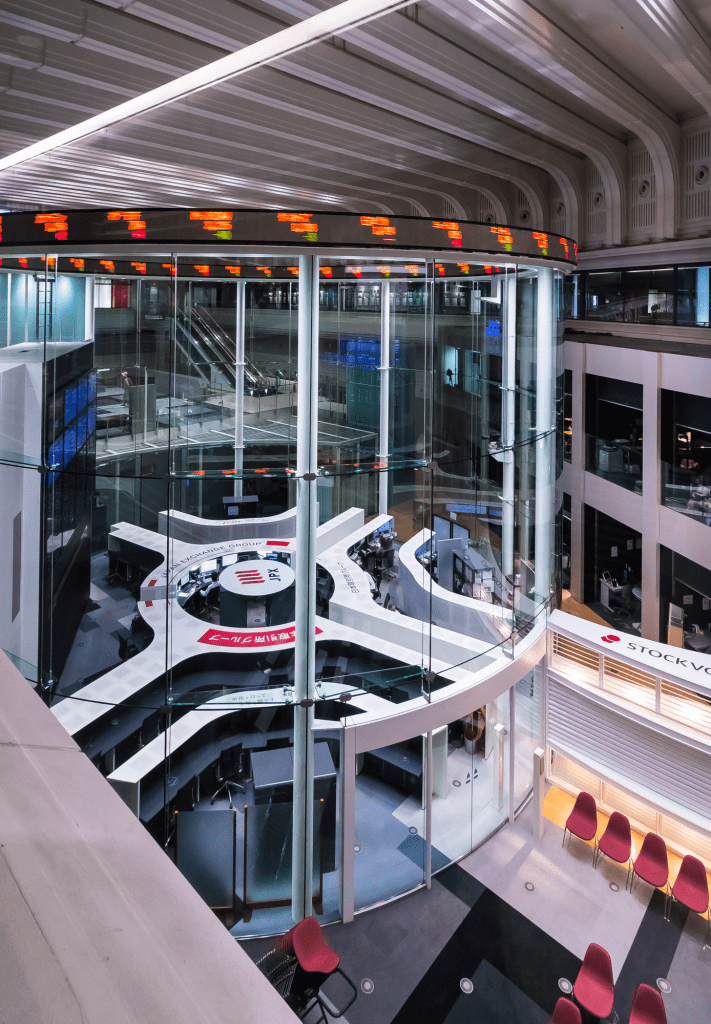
Although the service sector is the biggest contributor to Tokyo’s economy, it also prides itself on its financial sector. The Otemachi-Marunouchi-Yurakucho area is a thriving fintech hub, home to many prominent players in the Japanese fintech ecosystem—MUFG, SoftBank, PayPay (I love PayPay), etc. Tokyo is the financial center of the Asia-Pacific region, with the third-largest stock exchange (TSE), after the NYSE and NASDAQ.
The Greater Tokyo Area’s gargantuan share of Japan’s national GDP (40%) is not without its disadvantages. This concentration of domestic output is considered overwhelmingly high by international standards, as most nations do not have their national capital account for such a high share of their economy. It is comparable to the Seoul Capital Area of South Korea (50%) and the Buenos Aires Metro of Argentina (45%). Capital cities of similarly sized countries—such as the UK, France, Indonesia, and Mexico—hover at around a healthier 20%–25% of total GDP.
Possible Concerns
Population imbalance / brain drain
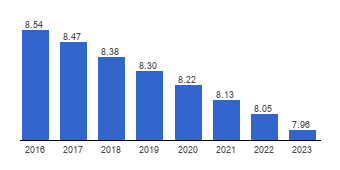
This problem is already quite prevalent, as Tokyo is one of the few regions of Japan with a growing population. Rural areas of Japan receive very little investment, which means that the number of attractive jobs is scarce, and people tend to flock to larger cities in search of higher-paying work. Tokyo’s average annual salary is ¥5 million ($34,600 USD), significantly higher than the national average of ¥4.6 million ($31,851 USD). Population decline in rural cities and towns is a real issue. What makes matters worse is that the work culture, cost of living, and population density make it a less-than-ideal place to raise children. Tokyo has the lowest birthrate of all the prefectures. These two issues combined cause rural economic stagnation (or even decline) and overall population decline in Japan.
Lagging start-up culture
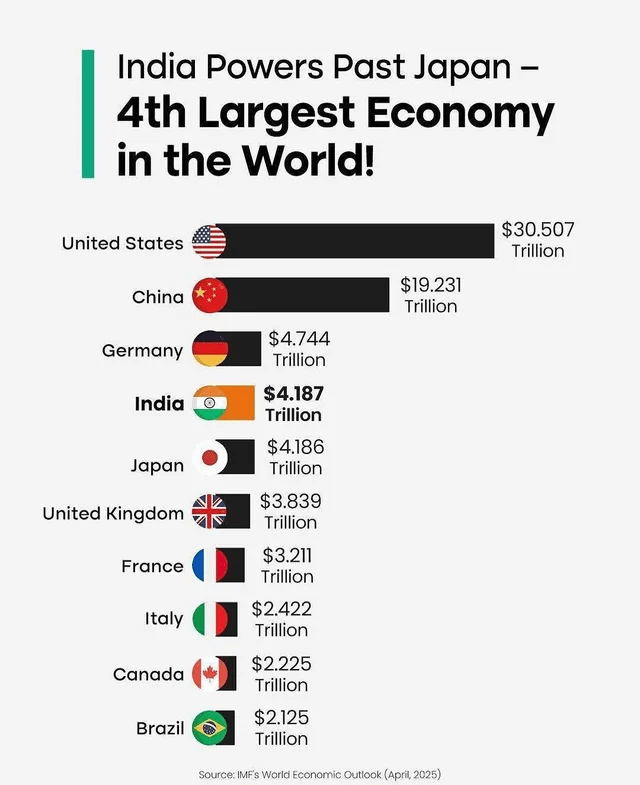
Despite the large population, the Greater Tokyo Area’s start-up culture is severely bottlenecked by its traditions and bureaucracy. People generally prefer lifetime guaranteed employment in large companies and tend to avoid start-ups. The culture of shame and failure-aversion also discourages entrepreneurship. As a result, Tokyo only ranks 10th in the world in terms of per-capita start-up activity. It is also ranked #10 by GSER 2024: Global Startup Ecosystem Ranking, behind other Asian cities like Singapore (#7), Beijing (#8), and Seoul (#9). Japan’s recent drop from the world’s 3rd-largest economy to 5th—surpassed by Germany and India—is likely due to cultural resistance to change, exemplified by its lagging start-up culture.
Natural disasters:
This one is self-explanatory. With all these major companies and infrastructures in one place, a large-scale earthquake or tsunami could do serious damage to the country’s people and economy. Even one week of Tokyo shutting down could have a devastating effect on the Japanese economy.
The Japanese government has tried to invest in rural regions—in their industries and tourism—but the efforts have largely been in vain. Despite this national crisis, Tokyo stands strong one of the best places in the world in terms of economic activity and job opportunities.
I often joke the other parts of Japan are just “Rural Tokyo”.
Tokyo’s Walkability
While the urban structure of North American cities like Vancouver, Toronto, Los Angeles, and Chicago is easy to understand (for the North American mind), Tokyo is quite different.
North American cities can be described as having a style of “monocentric downtown + auto-centric sprawl.” They tend to have a clear “downtown” area where the majority of businesses and corporations place their offices. Houses nested among the downtown area are rare and usually very costly. The downtown area is connected to various “suburban areas,” or “suburbs,” via train tracks and roads. The distinctly different atmosphere of the downtown and its suburbs can be felt immediately as someone leaves the city center—very few individual local businesses within walking distance, large houses with huge yards, and wide roads. This style of city, when compared to Tokyo, is less walkable.
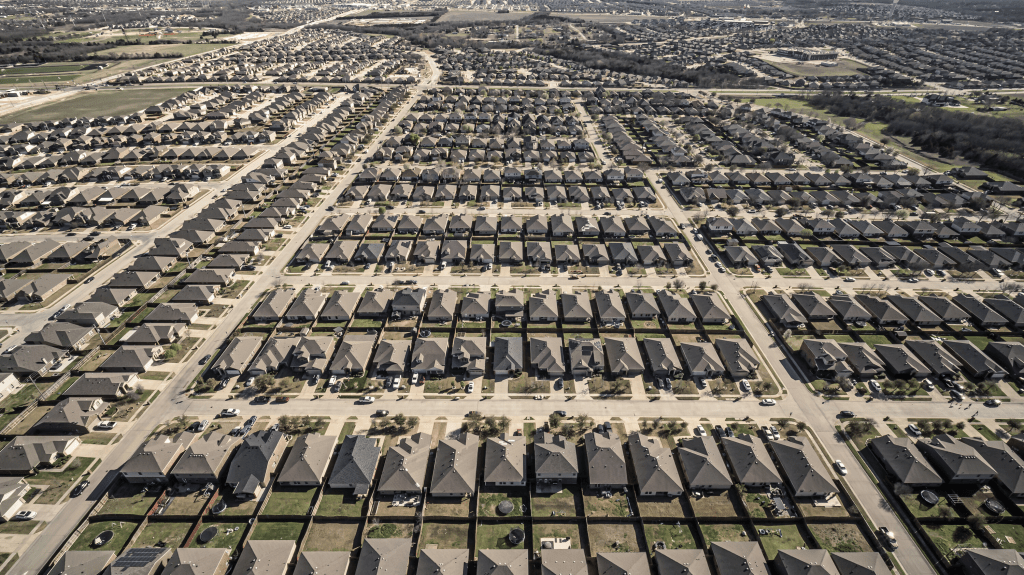
Of course, the walkability of NA cities also varies by design. Tokyo is rated at 90 for its walkability score, which is very high. This score takes into account proximity to daily necessities (groceries, schools, parks, restaurants, entertainment, transit, etc.), street grid analysis, block size, and mixed-use zoning.
- Vancouver: 80–85 (high)
- Toronto: 75–80 (moderate)
- Chicago: 75–80 (moderate)
- Los Angeles: 50–60 (low, highly car-dependent)
It is worth noting that while most major American cities (NYC, Boston, Miami, San Francisco) are around the 70–80 range, the average city in America falls in the 30–50 range.
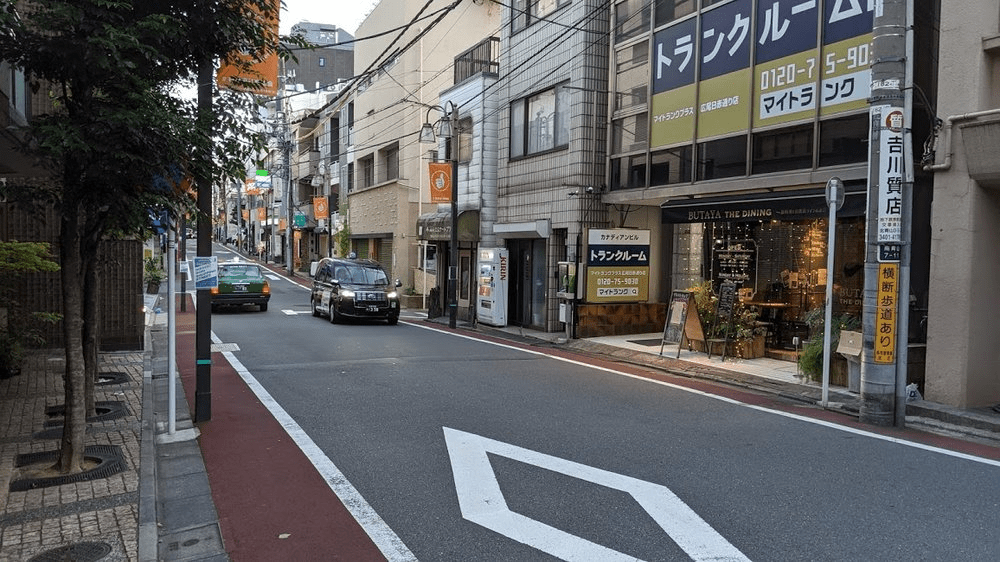
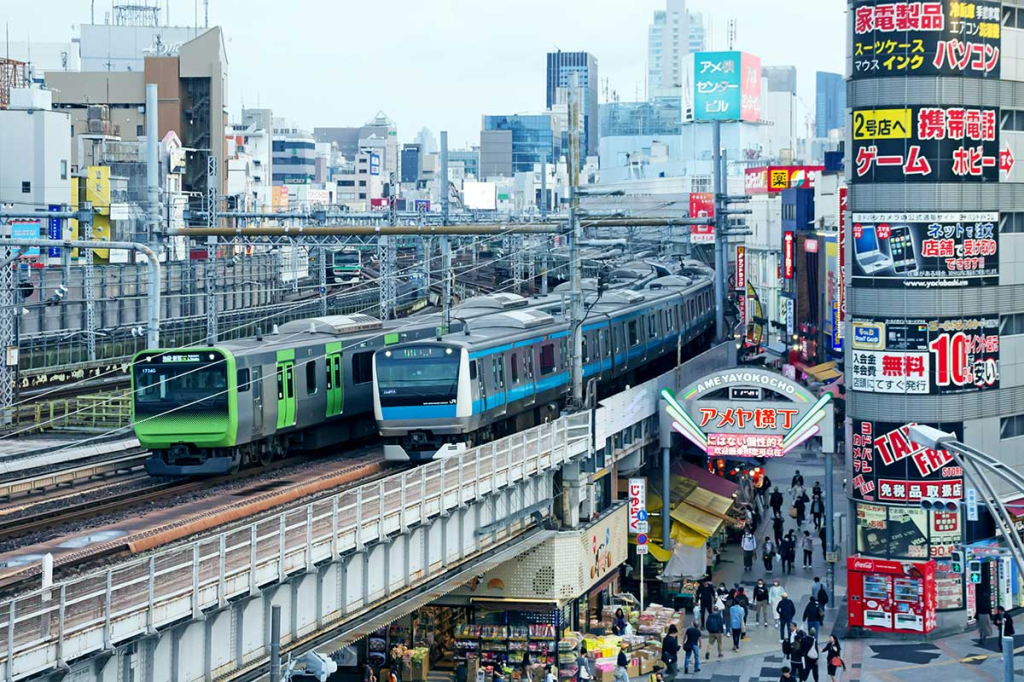
Tokyo’s urban structure is considered to be “polycentric.” It has no single “downtown Tokyo” (well, the entirety of the 23 special wards can be its “downtown,” I suppose). It has several urban centers, usually built around major train stations (Shinjuku, Shibuya, Ikebukuro, Ueno, etc.). If a station has multiple lines connecting to it, it can be considered a “downtown,” as commercial developments span horizontally and vertically outward from the train station.
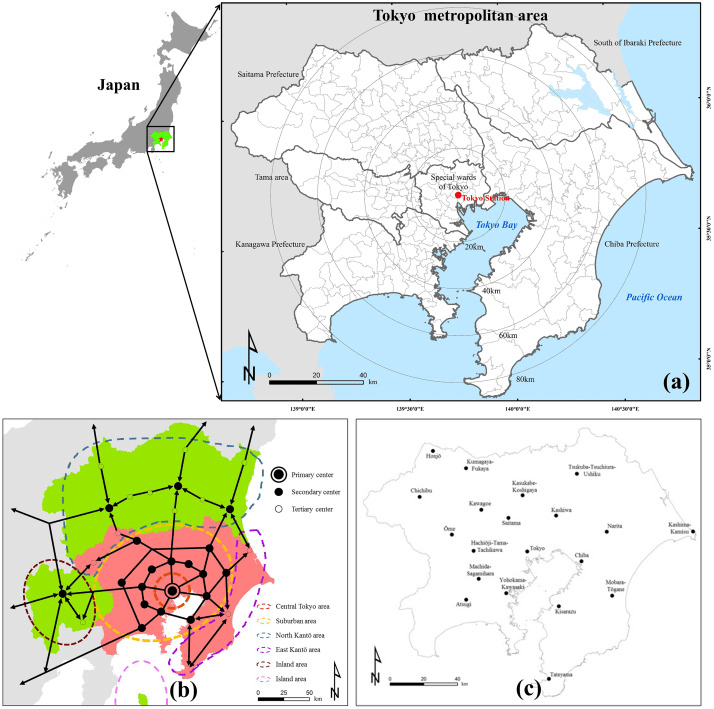
You can think of the 23 special wards of Tokyo as multiple cities stitched together by train lines and roads, each with its own identity.
Tokyo’s Public Transit System
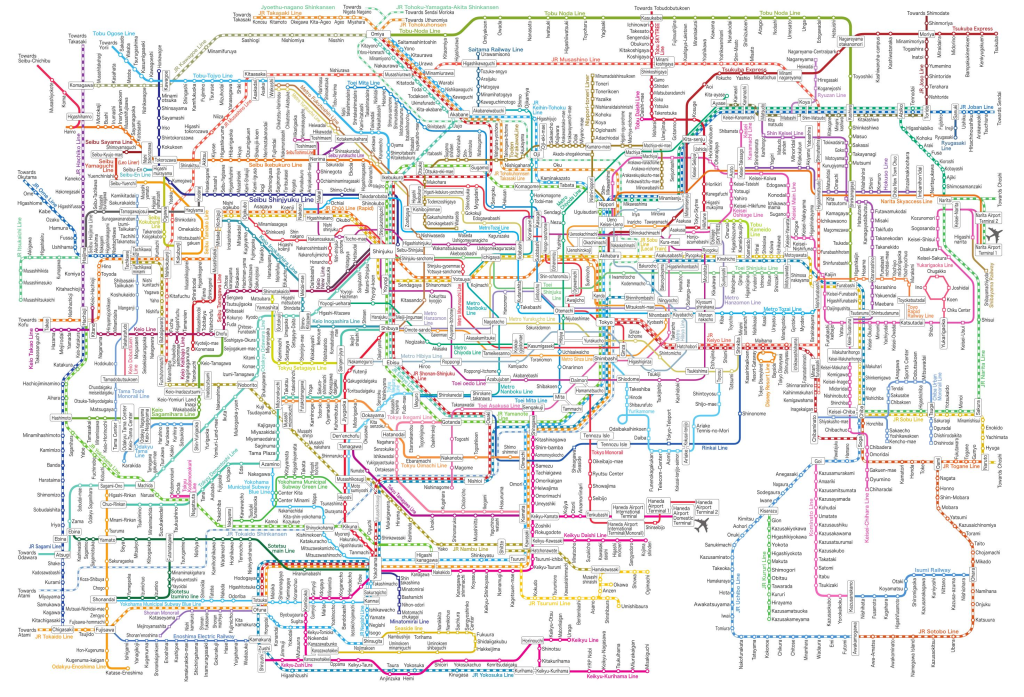
Tokyo is famous for its train system – with a length of 2194 kilometers total train lines. This completely dwarfs the next largest urban rail networks:
- Beijing – 879 km
- Shanghai – 808 km
- Guangzhou – 705 km
- Chengdu – 632 km
- Shenzhen – 585 km
Even compared to the railway building giants of Chinese cities, Tokyo still edges out by several degrees of magnitude.
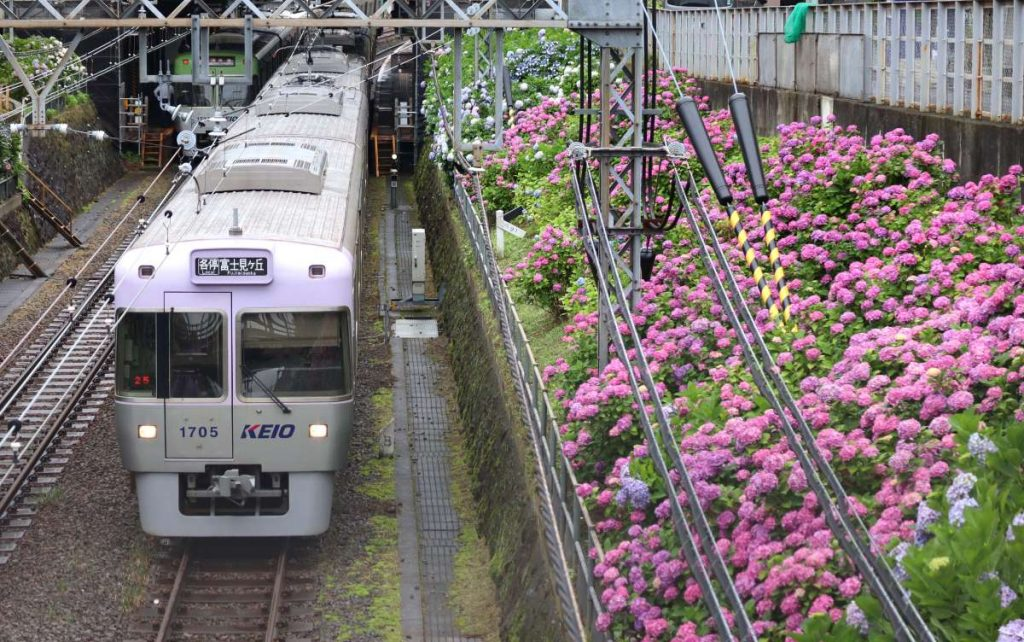
The trains are not only extensive, they are also highly punctual, clean, and fast. Although, that is only impressive for western standards. This is the norm for Asian train systems.
Interestingly enough, most of Tokyo’s train lines are actually not eligible for the definition of a “mass rapid transit” or “metro” system.
A mass rapid transit system has the following requirements:
- Confined within city limits
- Use their own specialized, exclusive tracks, no level crossings
- High speeds, high capacity, high frequency
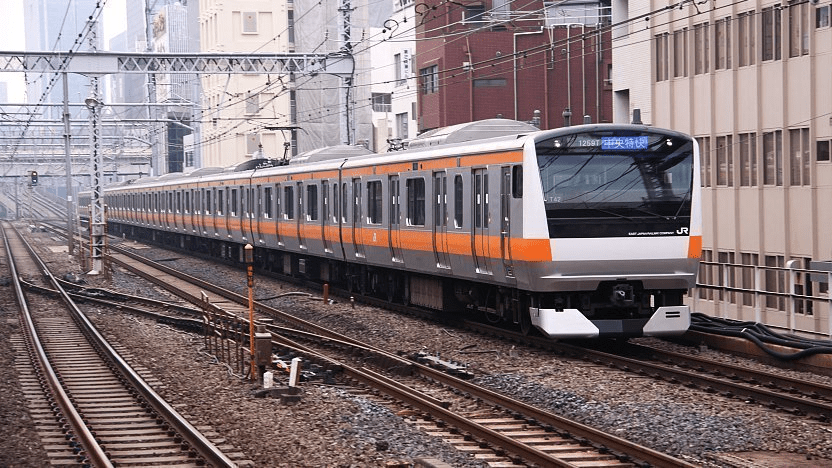
However, most of Tokyo’s train lines operated by JR, Tokyu, Keio, etc. are classified as “commute lines” because they don’t fit the 3 requirements. They usually start or end outside of Tokyo, share tracks with other train lines, use level crossings, and sometimes operate at low frequencies of stops in order to cover long distance. The Tokyo Metro is one of the only only train systems in Tokyo that fits the definition.
Cost of Living and Affordability
Tokyo’s cost of living and affordability is incredibly low, for a metropolitan area of this size. The average monthly cost of living is around $850 USD, and average rent at $930 USD, adding to a total of $1,780.
Other major cities and their cost of living + rent for comparison:
- New York City: $1,560 + $3,700 = $5,260
- London: $1,300 + $2,900 = $4,200
- Singapore: $1,200 + $2,400 = $3,600
- Seoul: $900 + $1,000 = $1,900
- Toronto: $1,100 + $1,900 = $3,000
Strictly in terms of costs, Tokyo is significantly lower than Western metropolitans. But of course, the cost of living alone isn’t a enough to measure the affordability of the metropolitan area, one account for income.
Taking salary into consideration, we can calculate the average % of salary spent each month on living expenses:
- Tokyo: 73%
- New York: 104%
- London: 110%
- Singapore: 91%
- Seoul: 86%
- Toronto: 94%
As we can see, Tokyo’s 73%, although still high, is vastly more affordable than its competitors.
The ability to save a meaningful amount of the monthly salary tremendously reduces the financial burden, and Tokyo is able to achieve this due to two major factors: policies and culture.
Policies
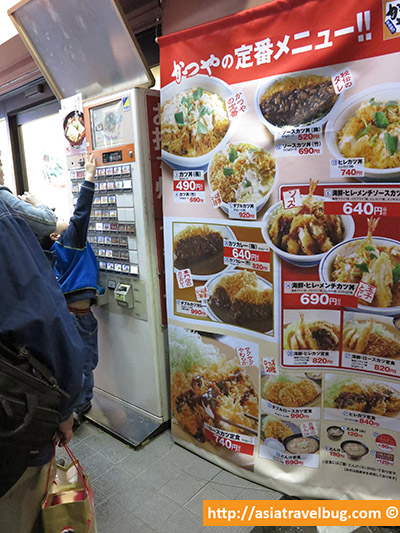
Various policies are put in place to keep the costs of essentials in Tokyo low, especially food and housing. Prices of food increase so rarely that when it does happen, it causes nationwide outrage, and the company usually issues a formal apology via video to maintain its reputation. These price increases are usually only about 10–20 yen at a time (~7 cents).
As for housing, new houses are constantly being built in Tokyo due to its “no land scarcity policy.” This abundance keeps housing prices stable or even declining. A person working a minimum wage job full time in Tokyo would be able to rent an apartment without a roommate, without compromising the quality of the apartment or the safety of the neighborhood—both of which are rarely issues in Tokyo.
The extensive train system is highly cost-effective and alleviates the transportation costs that many urban sprawl environments have. A typical Tokyo worker spends around $75 to $80 USD a month on transportation. Only 12% of the households in the 23 wards of Tokyo own a car. Without needing to pay for car loans, insurance, petrol, or a parking spot, Tokyo residents can enjoy rapid transit without breaking their wallets.
Culture
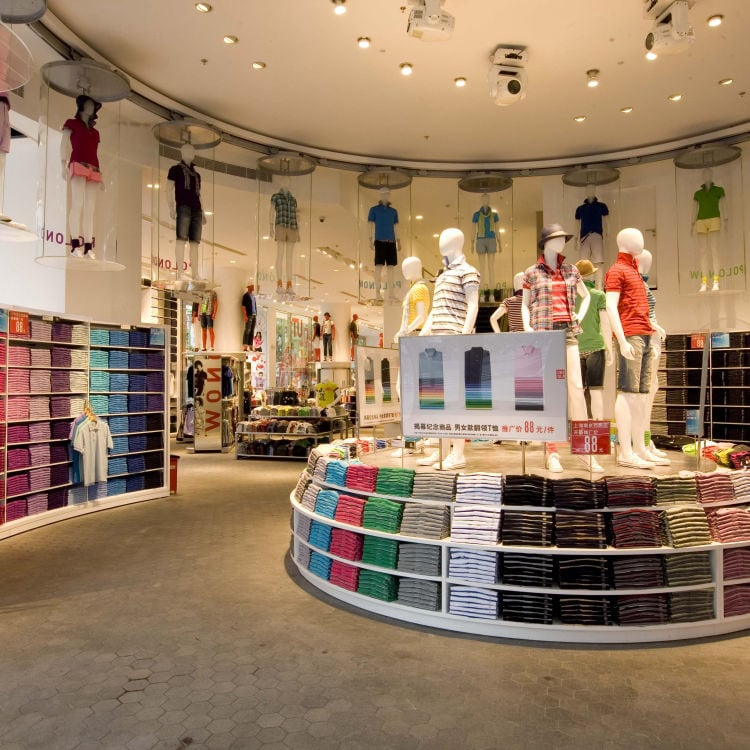
Japan’s culture rewards modesty and subtlety. There is a reason why NPC-like apparel companies like Uniqlo, GU, and Muji are some of the most popular brands here. Aside from a sense of national pride in domestic goods, the average Japanese person simply do not idolize over-the-top luxury brands as much as countries like South Korea, where luxury is essentially social currency. Japan’s simplistic lifestyle is evident even in Tokyo, the fashion capital. Without the social pressure to indulge in excessive consumerism, Tokyo is able to maintain its relative affordability.
Unexpected Similarity
Despite Japan being a capitalist country through and through, its pricing policies and culture influences its affordability to the level of a socialist country like China, where most major cities like Guangzhou, Chengdu, Wuhan, Hangzhou, and Nanjing hover around 70 – 80% for their respective cost-to-salary ratio (albeit much lower than Tokyo due to the generally lower GDP per capita).
The Expat Experience
It is worth noting that the affordability of Tokyo differs from residents to expatriate employees (expats). According to Mercer’s 2024 cost-of-living data, Tokyo ranks at #49 (dropped 30 places), making it one of the most affordable major cities in the world for foreign workers.
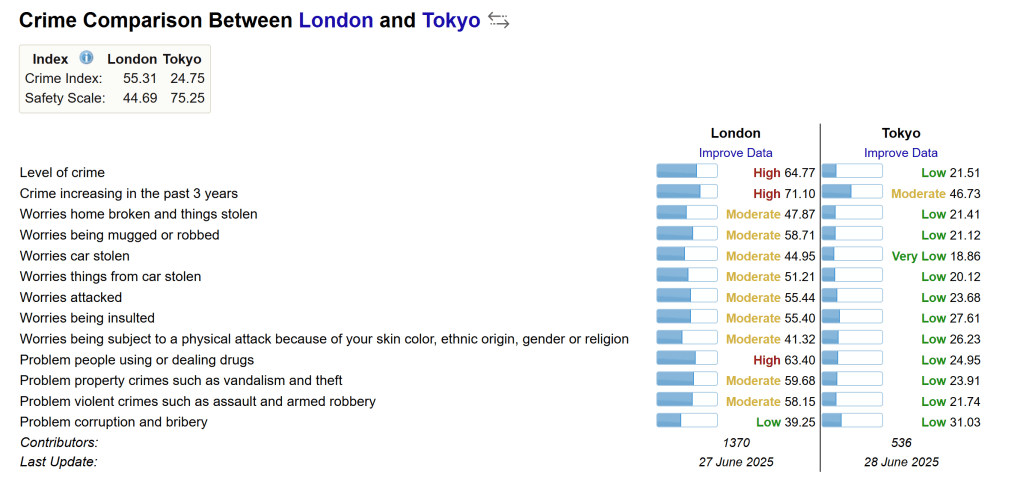
General Safety
Before I proceed with this section, let’s get the obvious out of the way. Tokyo’s ostensible “high safety” status is not without its caveats and nuances. There’s a reason for women-only train cars, a reason why every camera app has a shutter sound you can’t turn off, and a reason women are told not to live on the first floor. Sex-related crimes against women are still relatively high, and they are often not reported or are impossible to pursue legal action against.
With that said, Tokyo is the heart and soul of Japan—a nation with a high-trust culture. People are expected to act within their own boundaries and not cause trouble for others. This is a principle taught to every Japanese person from a young age. While it does put up walls between people, it creates a very safe society. People being insulted, attacked, or robbed in public is extremely rare, even in the more dangerous neighborhoods. Homes and cars are hardly ever broken into. When a stabbing occurs—if ever—it makes headlines on national news. Large-scale attacks such as mass shootings, like in the United States, are unimaginable here (to be fair, they are unimaginable almost everywhere else in the world).
Tokyo is a fairly international city, so locals here are used to seeing foreigners everywhere. The tolerance for foreign culture is also relatively high compared to other parts of Japan. Physical or verbal violence based on skin color, race, or religion is fairly low as well. This is not to say that racism does not exist here. Discrimination and prejudice most definitely are issues. Some restaurants explicitly state that foreign customers are not allowed in, and some apartments will refuse to rent to non-Japanese people. This is enabled by the lack of anti-discrimination laws that we have back in Canada. It’s just that these prejudices rarely manifest as verbal or physical hate crimes like we witnessed against Asians during the COVID era in the United States.
People—even women—can walk by themselves outside at night without worrying. They often leave their cars running on the road while attending to something. Even if you leave your phone or wallet in a toilet stall, you can come back 10–20 minutes later and find it still there, or returned to a worker at the establishment. This sense of security—that you don’t need to be clutching your purse or constantly aware of your surroundings—is addictive.
The vast majority of East Asian cities are extremely safe, due to their cultures and legal systems. I really hope Canada can do better.
Cleanliness and Air Quality
Japan is famous for its orderly and cleanliness, absolutely unparalleled in the world. People who have never been to East Asia would have a hard time even imagining the level of cleanliness here. It is quite normal to walk around a city or town in Japan for hours and not see a single piece of trash littered on the ground.
Surely, as the biggest metropolitan area of Japan with such a high population density, Tokyo is the exception to that rule, right?
Cleanliness
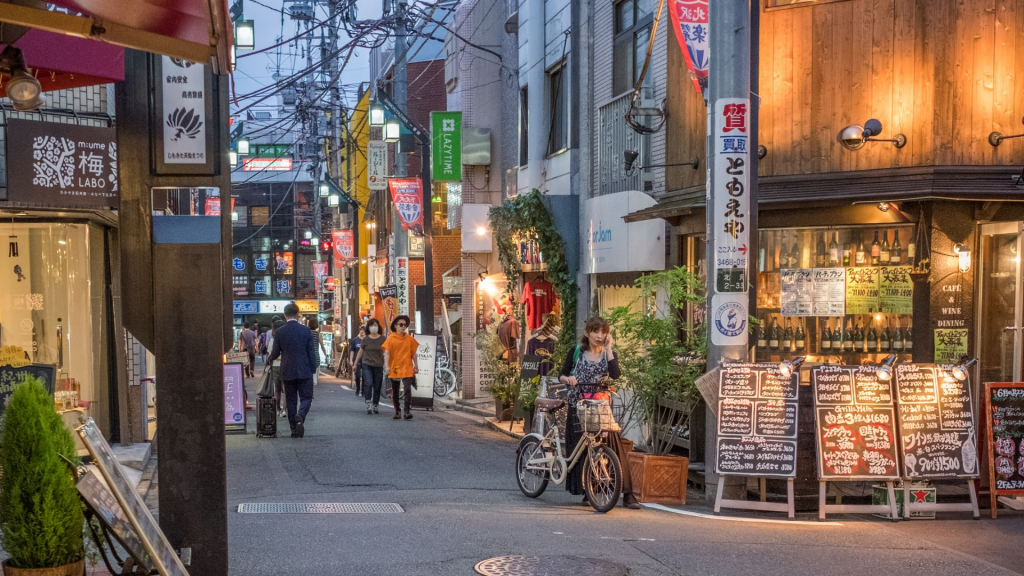
Tokyo is by no means a spotless paradise, but it is noticeably, and, by a significant margin, cleaner than most of the major metropolitan cities in the world. Even without any public trash cans, people just generally do not litter. This unique phenomenon is a result of Japanese culture and by extension, education. Japanese people are taught from a young age to practice self-constraint and show respect for the shared public spaces. This can actually be observed in multiple facets of Japanese society.
People sort their recycling exactly according to the guide. Plastic, cardboard, paper, bottles, burnables, leather, glass, etc., are all sorted properly. After using public facilities, people will return it exactly the way they found it. They will clean up after themselves at restaurants, toilets, sporting events, movies, venues. When viewing concerts and movies, people will quietly observe and try their best not to ruin others’ viewing experience.
The clean streets is another charming points of Tokyo that very few places in the world can offer. However, it also begs the question of why this level of cleanliness is not a goal that western cities pursue. It is because the path to achieve cleanliness is the antithesis of the western multi-cultural liberal ideology that promotes individuality over conformity.
Air Quality
Tokyo is not only clean in its streets, but also in its air. For a metropolitan area of this size, it is highly healthy. The 2024 PM2.5 (fine particulate matter) data shows that Tokyo had an average PM2.5 (minigrams per square meter) of 4, which is very good.
For comparison (2024 data):
- Seoul: 17.6 (moderate)
- Beijing: 30 (moderate – unhealthy)
- New York City: 12 (good)
- Berlin: 10.8 (good)
- Delhi: 104.7 (very unhealthy)
- Vancouver: 4.2 (very good)
Tokyo’s extraordinary air quality is credited to a few things. Most people rely on public transit to travel around. The few that do drive, their vehicles need to meet strict emission standards set by Japan. Tokyo also does not have any industrial zones in the city core. Of course, many other factors are at play, but this impressive feat is extremely rare around the world.
International Cultural Center
Whether it is to live in, or visit, Tokyo is a top-tier location for all things entertainment. As the economic and urban center of Japan, Tokyo is also the de facto modern cultural center of the country. Tokyo stands at the top of very facet of modern entertainment compared to other major metropolitan areas in the world. Cities that can challenge Tokyo’s status as an international cultural center are far and few between.
Music
Unknown to many, Japan actually has the 2nd largest music industry in the world after the United States, at around half of American music industry’s total annual retail value. Considering the Japanese music industry is almost entirely targeted at its domestic audience, unlike the American or Korean music industry, this is a very impressive feat.
Unsurprisingly, Tokyo has an extremely thriving music scene. As a fan of Japanese music, I have experienced first hand their concerts (or “live”, as they say in Japan, “concert” refers specifically to orchestral concerts) from underground live houses in Shimokitazawa that barely fit 50 people, to the gigantic Saitama Super Area with 37,000 seats.
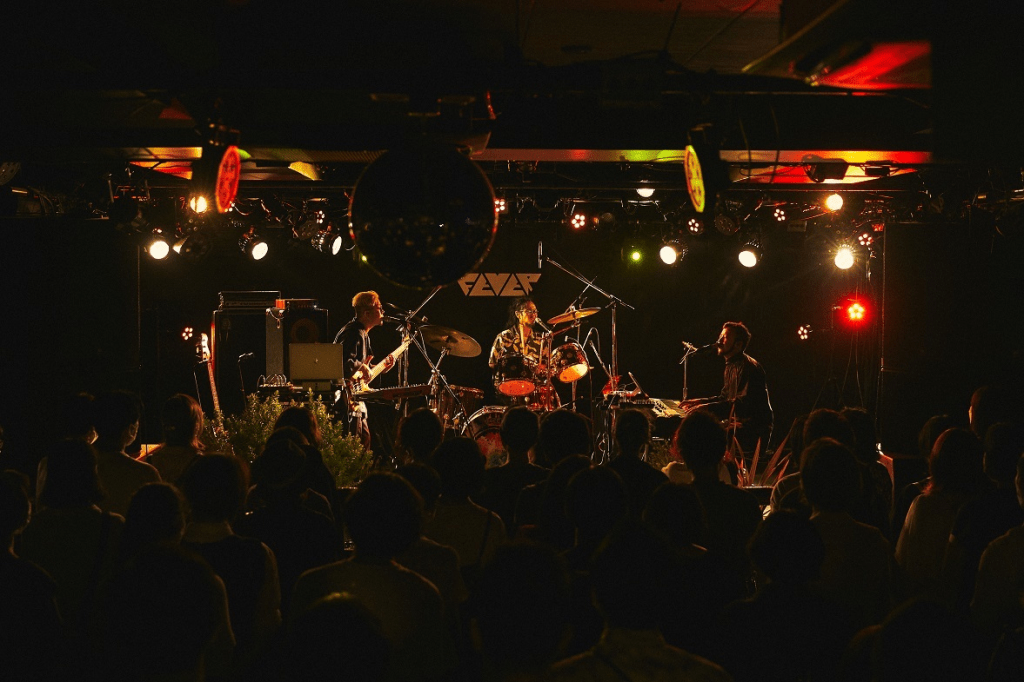
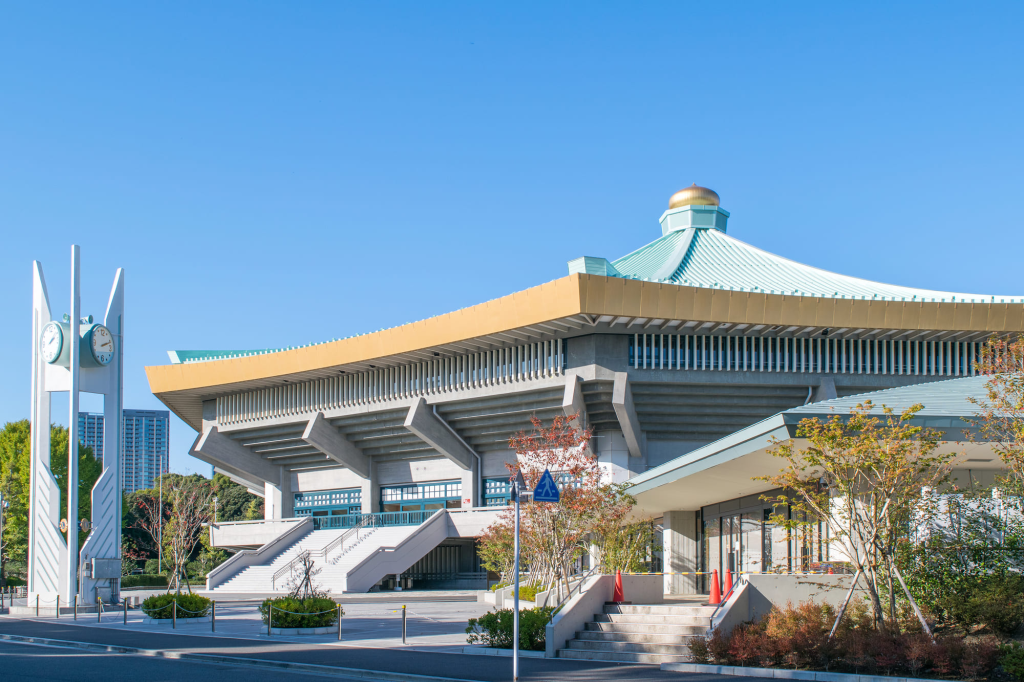
The Greater Tokyo Area is home to over 600+ live houses, 429 general live-music venues, 201 formal concert halls, and 10+ major arenas with capacity of 5000 – 40,000 (Saitama Super Arena, Tokyo Dome, Budokan, etc.). With a combined number of over 1000 venues, there is no metropolitan region in the world that is at Tokyo’s level. The only comparable regions are the New York State (~819 venues), the United Kingdom (over 950 venues), and California State (~1245 venues).
Conventions and Events
Tokyo is also by far the largest host of entertainment conventions and events. Everyone knows that Tokyo is the anime capital of Japan, but it also boasts an enviable range of events in gaming, cosplay, comics, tech, idols, and others.
Some major examples include:
- Tokyo Game Show: gaming convention; 200,000+ attendees
- Comiket (Comic Market): self-published manga, cosplay, fan culture; 750,000+ attendees
- AnimeJapan: anime, studios, voice acting, merch; 150,000+ attendees
- Jump Festa: Shounen Jump manga and anime; 100,000+ attendees
- Tokyo Idol Festival: Idol performances; 80,000+ attendees
- Design Festa: art, fashion, crafts; 60,000+ attendees
- NicoNico Chokaigi: internet culture, streamers, vocaloids, gaming; 100,000+ attendees
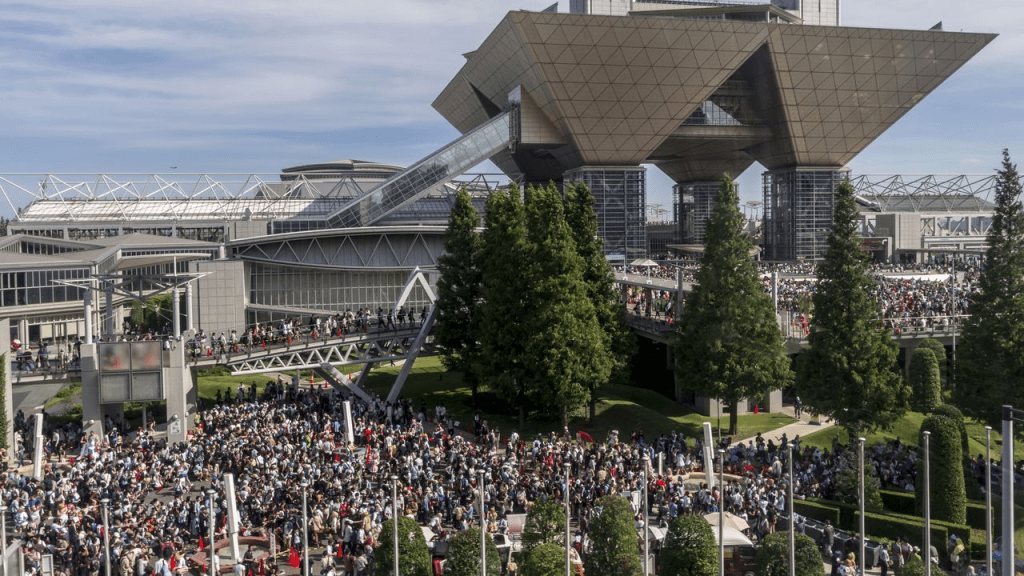
For reference, one of the largest conventions in the United States, The New York Comic-Con has 200,000+ attendees. It is the equivalent of a relatiely large sized convention in Tokyo.
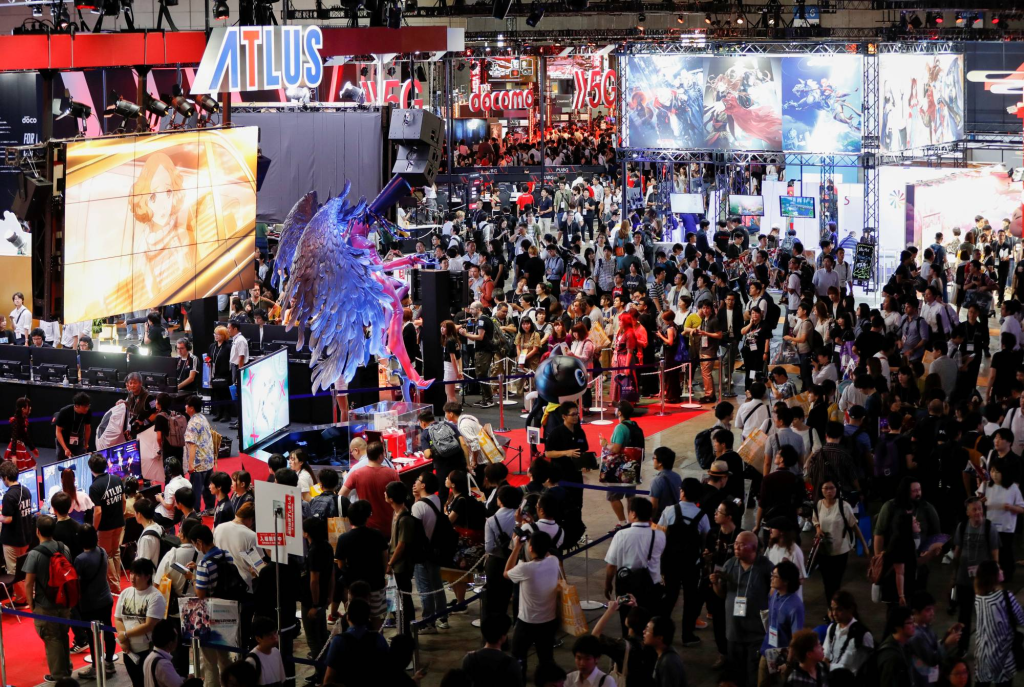
Tokyo’s conventions win in both scale and frequency. There are 50-100+ major events every year, whereas cities like Los Angeles and NYC have around 40 and 30 respectively.
Food
Tokyo is also easily the food capital of the world. Within Japan, Osaka is considered the “kitchen of Japan” due to its local cuisine, but Tokyo’s rapid economic development attracted a huge number of high-quality restaurants setting up shop here.
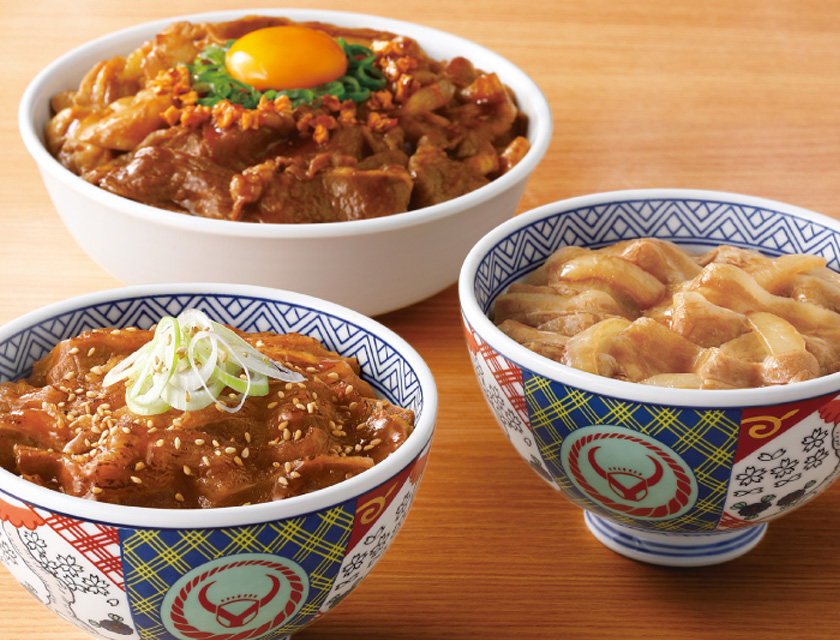
Tokyo has over 60,000 restaurants in total, ranging from daily eats to high-end fine dining. Even for $5 USD, you can find very high-quality gyudon or ramen all over the metropolitan area. Restaurants, department store food halls, yatais (food carts), izakayas, bars, and fast food chains are highly abundant.
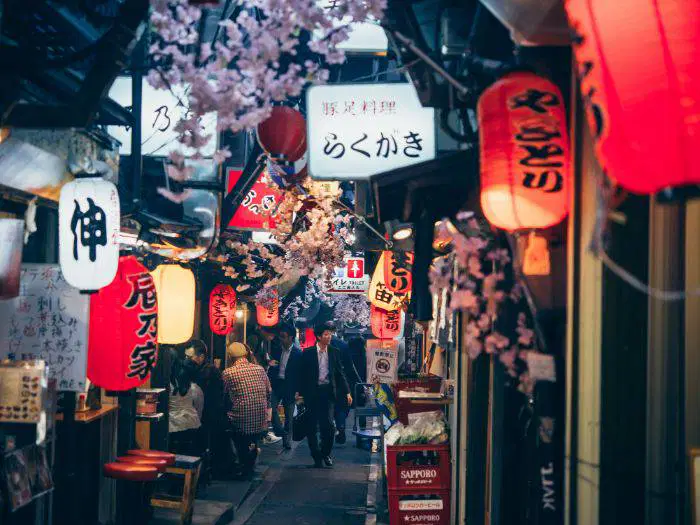
For comparison:
- Paris: ~45,000 restaurants
- New York: ~25,000
- London: ~27,000
—absolutely dwarfed by Tokyo. Tokyo not only has the scale but also the consistency in taste, quality, and cleanliness. Every meal, even budget options, is made with extreme care and precision. Japanese people generally just do not believe in cutting corners, and food portions are distributed evenly and accurately. You will most likely get exactly what you see in the photo. Due to strict sanitary policies, food served in Tokyo generally has no health concerns. There is also a great variety of options, with cuisines from all over the world concentrated here. Personally, I love to visit the Ikebukuro or Shin-Ōkubo area to eat Chinese food!
Lastly, Tokyo also dwarfs other cities in the world when it comes to fine dining. With over 200 Michelin stars, it has nearly double the amount of stars as the second-place city, Paris (~120 stars)—often at lower price points as well.
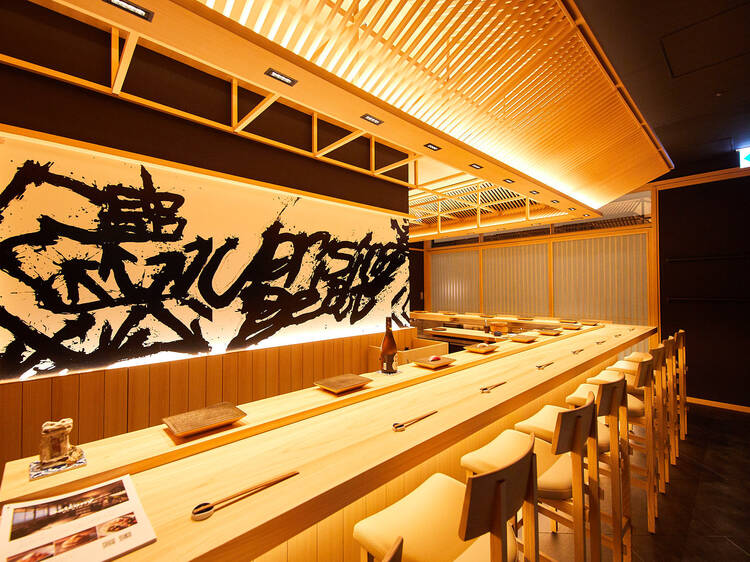
The concept of “bad food” in Tokyo (and Japan as a whole) is not the same as in the West. Even a “subpar” restaurant here can rival a “decent” or “good” restaurant in Canada. The Japanese craftsmanship and dedication to their work is unrivaled by other countries. From affordability, consistency, cleanliness, to taste, Tokyo is undoubtedly the #1 food capital of the world.
Fashion, film, gaming, and more
If I were to keep talking about the modern culture of Tokyo, this section would go on forever. I will briefly discuss what else Tokyo has to offer:
- Fashion: ~2940 clothing stores (43% indie boutiques, 57% brand chains like Uniqlo, GU, Zara, etc.)
- Harajuku, Shimokitazawa, Ginza, Koenji are the well known fashion districts
- Film: 634 feature films produced in 2022 (fourth place worldwide)
- Major studios are based in Tokyo: Toho, Toei, Mappa, Studio Ghibli, etc.
- Popular location to be featured in international films
- Gaming: 509 gaming arcades in Tokyo
- Akihabara, Ikebukuro are the main hubs for gaming
- Disney: 2 Disney theme parks – Tokyo Disneyland and Tokyo Disney Sea
- Shrines and temples: over 1400 shrines and 1,000 temples in Tokyo
- Senso-ji (Asakusa) and Meiji-jingu (Yoyogi)
- Night life: themed bars (robot, maid), karaoke chains,clubs, and izakaya are spread all over the city
- Shibuya, Shinjuku are the most popular areas for night life
- But don’t stay out too late, most trains stop running at 12:30 AM!
- Seasonal events: cherry blossom viewing, firework festivals (matsuri), and others
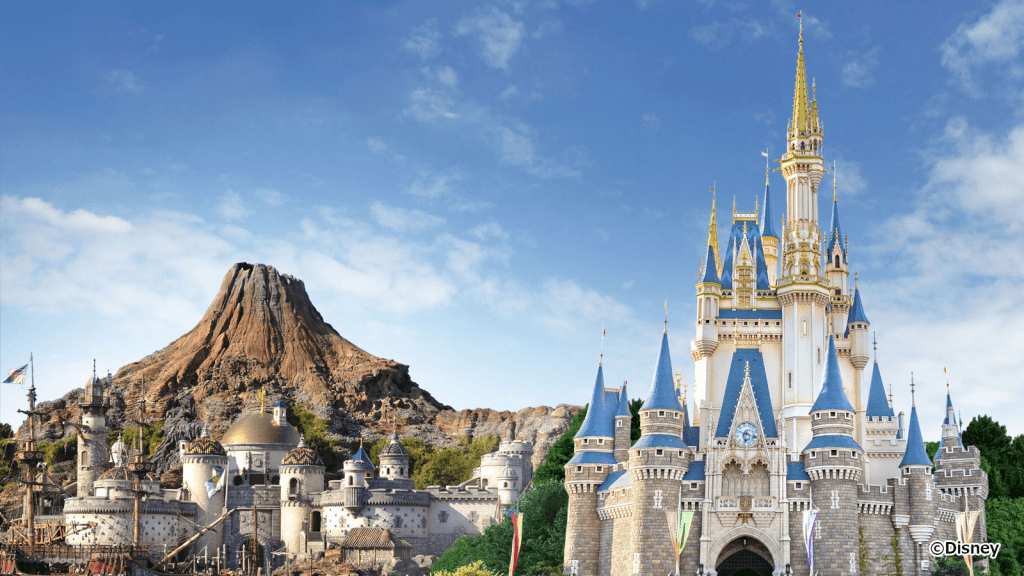
There is a reason Tokyo not only attracts Japanese people from all over the country, but visitors from all over the world. There is not a single day without something exciting going on. Just by walking down the streets of Shibuya, you will encounter at least 20 events happening with hundreds of attendees. From an anime-themed exhibition, to an idol group meet and greet, to a beer festival, the amount of things to do is overwhelming. Tokyo may bring out many emotions in people, but bored is definitely not one of them.
The Bad
A walkable, affordable, and clean place that has an abundance of entertainment, great food, and multiple thriving industries? Tokyo must be paradise on earth!
I’m about to shatter that perfect and dream-like image you have of Tokyo.
Once again, I cannot stress enough that my experience as an expat is significantly better than that of a typical local resident worker in Tokyo. Tokyo has what I call the “loneliness pandemic.” This is not of the same nature as the South Korean gender divide or the red-pill movement in the Western world, but something that is somewhat unique to Tokyo—and Japan as a whole.
The loneliness pandemic is the reason why Japan is infamous for its problematic birth rates and suicide rates, and it is caused by a variety of deep-rooted social and physical factors.
Tokyo’s Work Culture
Japan is world-famous for its toxic work culture. People in office jobs typically work from 8:00 AM to 8:00 PM on a standard day, with a ton of unpaid overtime—driven more by social pressure and obligation than actual necessity. A study showed that the average worker in Tokyo does around 22.2 hours of overtime per month. Note that this figure is likely heavily underreported, and could realistically be 30–40 hours.
I’ve heard stories about salarymen not being able to leave their office until 1:00 AM, missing the last train, and having to find a hotel or 24-hour internet café near their office to stay the night—only to return to work the next morning.
Nomikai
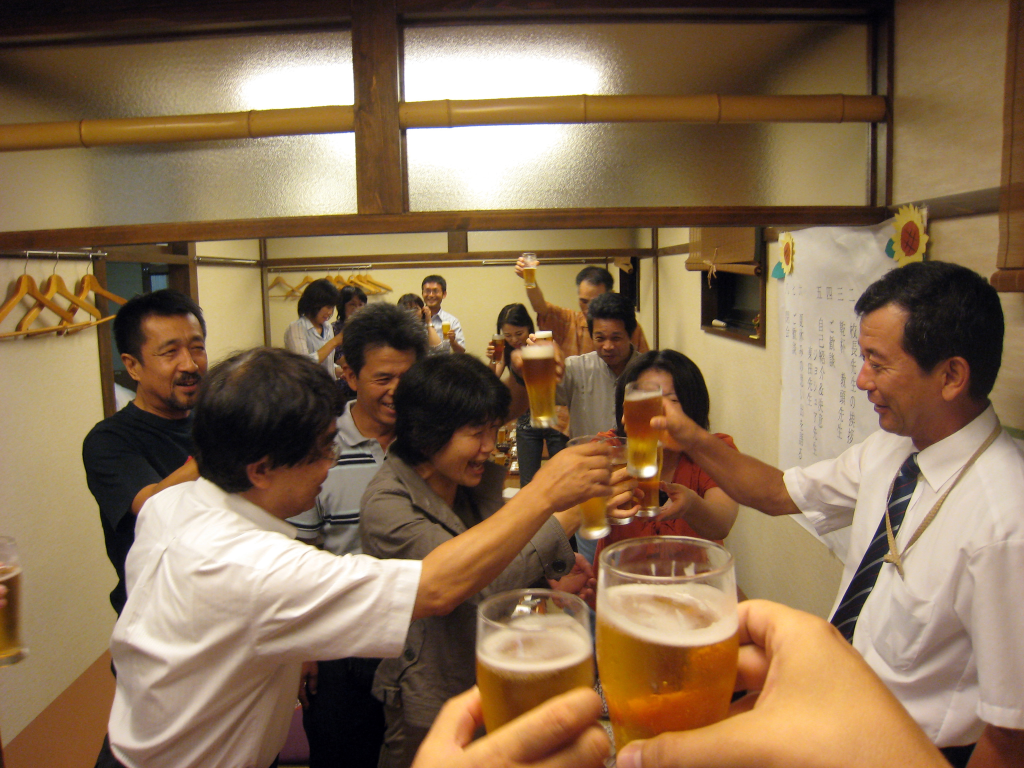
Japan’s workplaces also have this thing called a “Nomikai” (after-work drinking party). It is exactly what the name suggests—the boss makes the declaration near the end of the workday: “Let’s go drinking!”, and everyone goes to a local izakaya to hang out with their boss. It’s voluntary on paper, but only if you don’t care about establishing a good rapport with your boss.
Luckily for me, my workplace does not have a nomikai culture, because I would actually hate it (I don’t enjoy drinking). But many of my friends here who work in “real jobs” experience nomikai typically once a month.
With a work schedule like this, who has any time to maintain friendships—let alone make new ones or seek out relationships? Even if the worker is already married, their poor work-life balance is something they must consider when it comes to having children. Would they have the time and energy to raise a child?
The reality is that many households divide the breadwinner and childcare duties—typically, the father being the worker and the mother being the caretaker. But raising a child is expensive, and not many families have the financial strength to do so.
Work Hierarchy
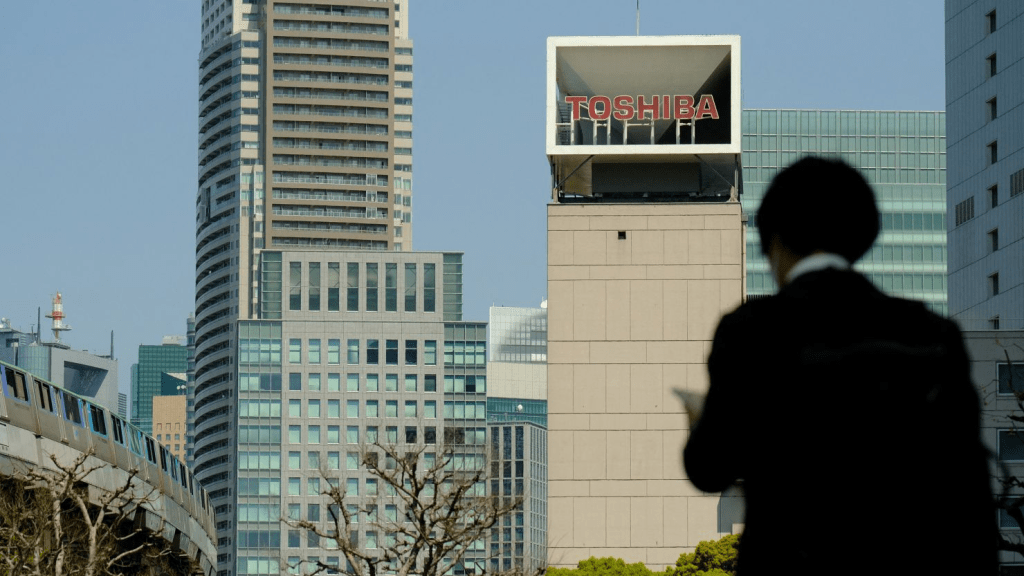
The working schedule and drinking culture aren’t the only frustrations with Japanese work culture. The rigid hierarchical structure is arguably the biggest contributor to the declining economy. After the “Economic Miracle of Japan” from the 1950s to the 1980s came the “Lost Decades” of economic stagnation in the ’90s. What once made Japan so great became the reason for its downfall.
Japan in the ’80s was known for its world-class innovation and manufacturing, making new and shiny products that work and last. Nikon, Canon, Nintendo, Toshiba, Sony, Toyota, Honda, Nissan, are all houeshold names known worldwide.
The success was made possible due to Japan’s culture of not cutting corners, following rules, and respecting corporate hierarchies. However, in today’s world, fast-paced innovation is king—and Japan simply can’t keep up anymore. Changes go through multiple layers of approval—an unnecessarily long process, if they happen at all. To make matters worse, due to the age focused hierarchy, the system is highly discouraging for young workers, who are often the first to be exposed to innovative policies and creative solutions, but feel hopeless in an economy dominated by traditional corporate giants and red tape.
Bureaucracies are great at preventing bad policies, thus maintaining quality, but terrible for adapting to the new age.
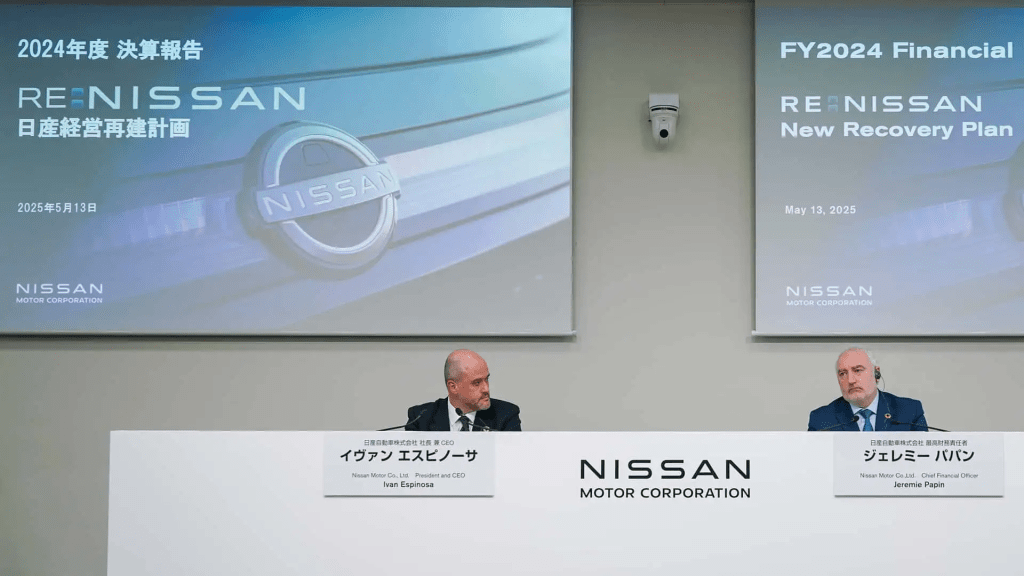
This issue is prominent throughout Japan but most pronounced in Tokyo, due to the density of long-standing Japanese companies here.
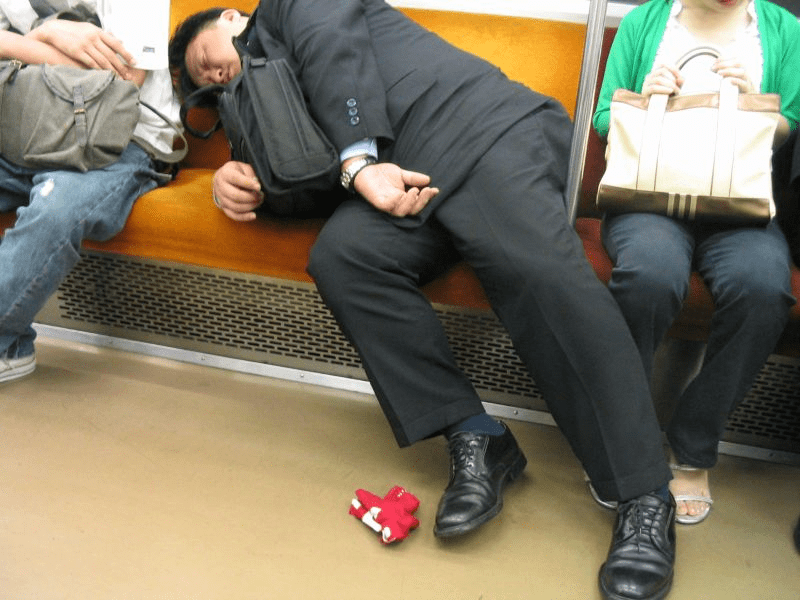
If you ever take a late-night train in Tokyo full of suited salarymen, observe them. See their depressed, defeated, and overexhausted expressions. They were all once young and optimistic about their future, hoping to serve their country—only to be pushed down by reality.
Aspired to lead Japan into the future, forced to become a cog in the giant, rusted machine.
People aren’t meant to live like this.
Tokyo’s Social Culture
Japanese people, especially Tokyo people, are known to be very polite. They bow, they smile, and are very respectful and careful with their words. This usually creates a very positive impression on tourists, who are not able to unravel the deep-rooted problem this causes.
For starters, as a non-Japanese person, I have to say that this is not meant to be an insult to a culture that is not mine. It is merely a commentary on the irrefutable issue that plagues Japanese society, and an attempt to use social culture as an explanation for why it occurs.
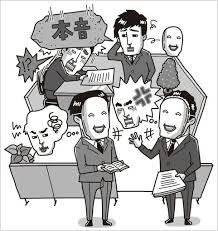
The politeness and manners are sometimes taken to an extreme—a phenomenon called “Tatemae” (“建前”). Tatemae is the face you display to others to hide your true feelings, or “Honne” (“本音”). Every culture does this to a certain extent, of course. No one is 100% honest all the time, because social harmony would completely collapse. Japan just takes it to the next level.
Many people here express difficulty in creating genuine connections because Tokyo people tend to give you the “nice” response rather than the “real” response. With a constant wall up, it’s hard for people to connect on an emotional level. Even my Japanese friends from other regions of Japan hold this opinion about Tokyo people.
In many parts of the world—such as Nigeria, China, Canada, America, Thailand, and the Philippines—you can have a nice conversation with a stranger and become lifelong friends really quickly. Tokyo is not one of them.
Lonely people here are a dime a dozen.
Tokyo’s public and private infrastructure
In this section I will be using the word “infrastructure” semi-loosely.
Tokyo Brutalism
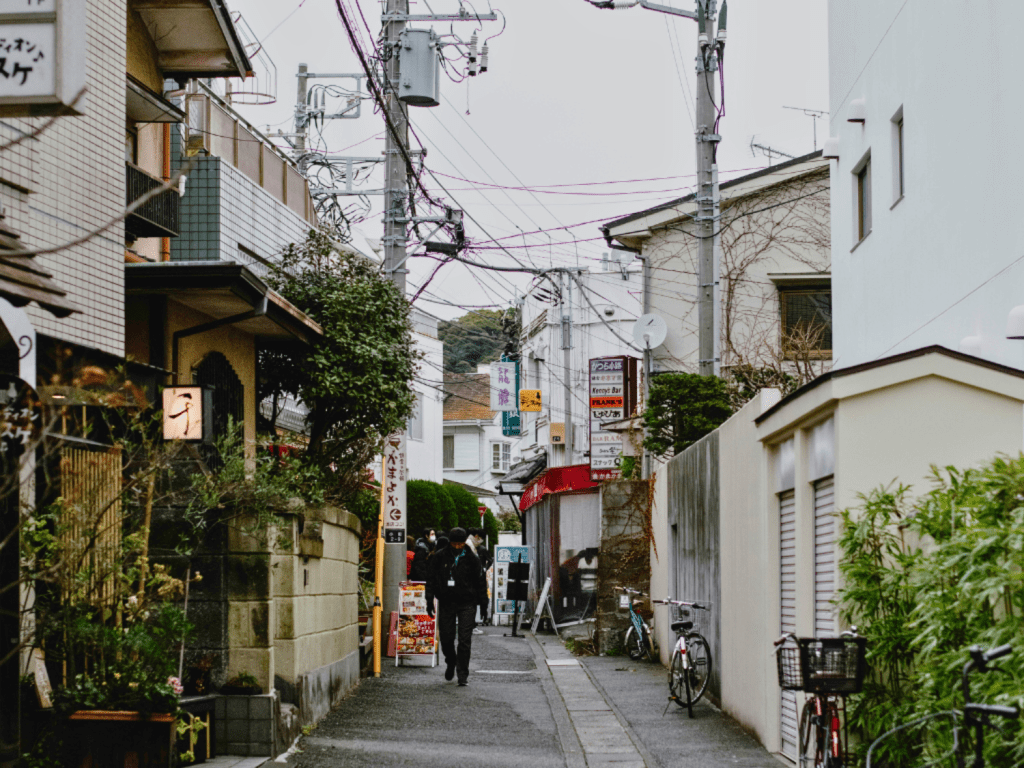
If you walk down the clean streets of Tokyo, you may notice a few things. The number of vending machines, the brutalist concrete architectural style, and the lack of public seating.
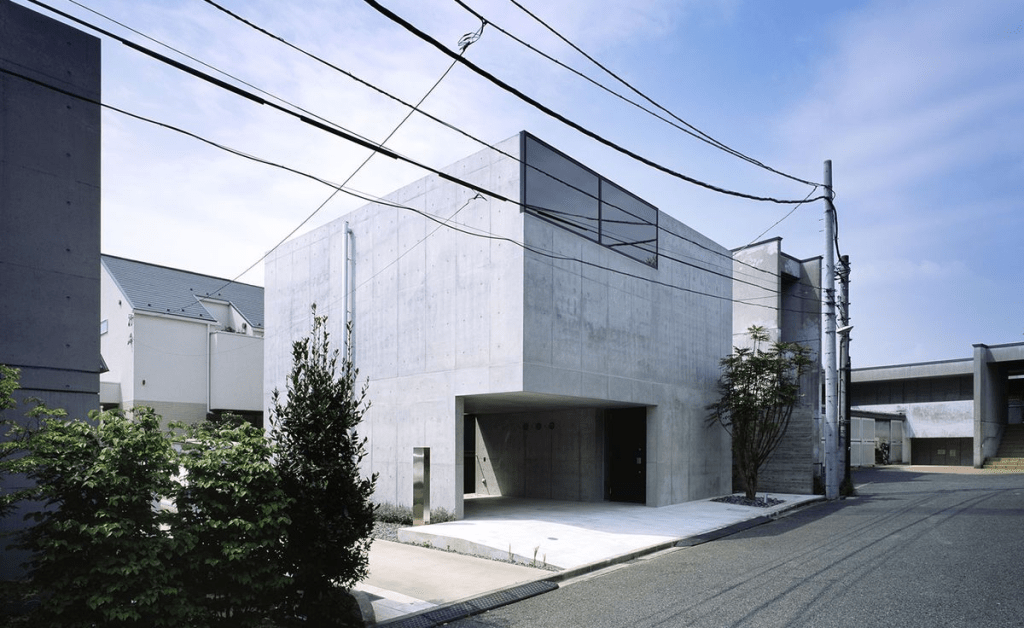
Tokyo is one of the few metropolitan areas in the world that have virtually no public seating available. The rare occurrences of seats are in the form of uncomfortable skinny benches, or railings that you can barely sit on. These are part of the metrpolitan area’s anti-homelessness strategy, to reduce the amount of sleepable surfaces or just make them very uncomfortable.
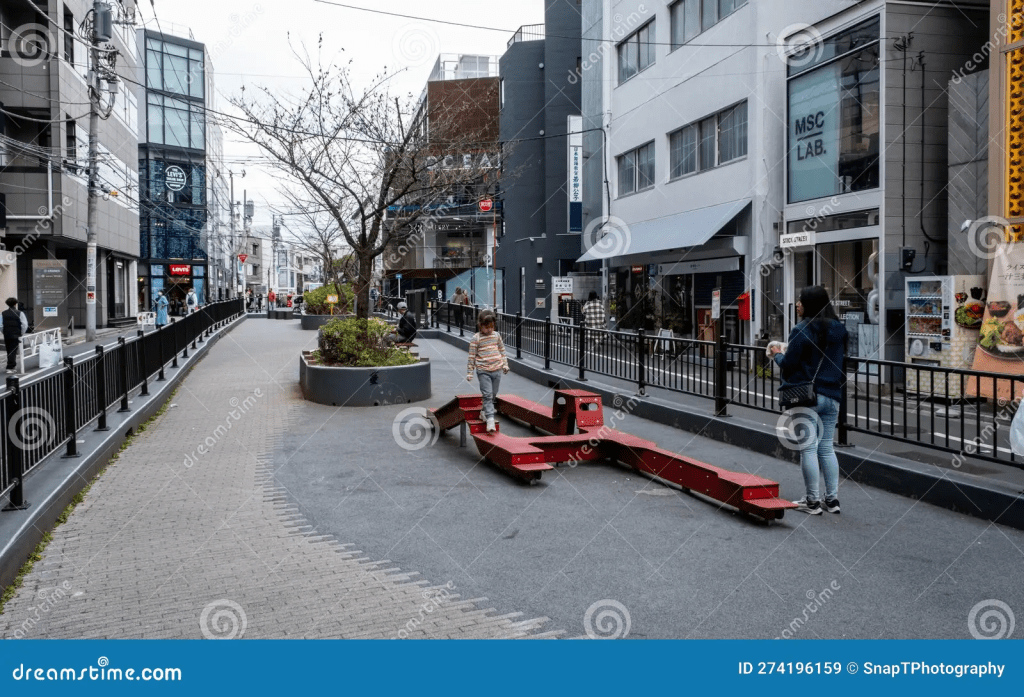
As a result, Tokyo’s roads feel like liminal spaces that are only meant to bring you from point A to point B. Although it is impossible to quantify the impact of this particular aspect of the urban planning of Tokyo on the loneliness or depression index, I can’t imagine it’s completely irrelevant.
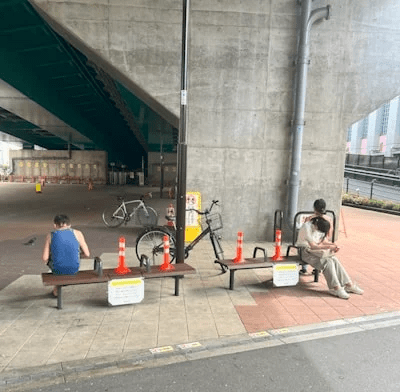
As a play on word on the brutalist architectural style that Tokyo loves so much (as do I), I joking like to refer to this observation as “Tokyo Brutalism”
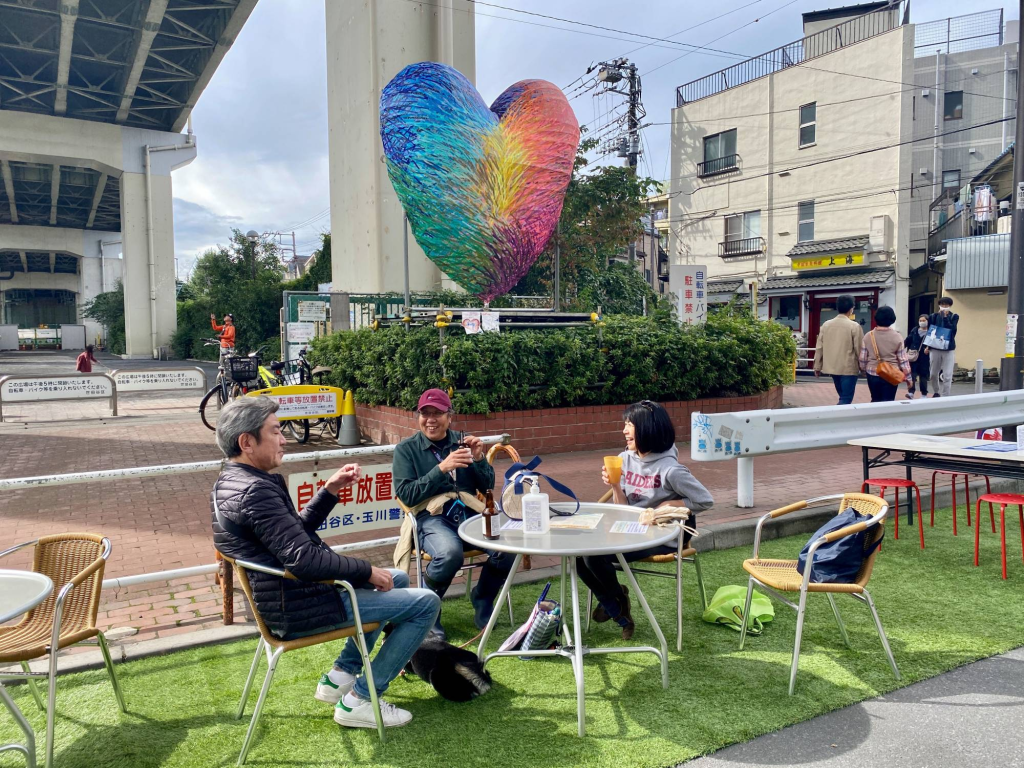
Lack of Free 3rd Spaces
The term “third space” has risen in popularity over the past few years. It refers to a place outside of the first space (home) and second space (work), where people can gather and socialize.
In terms of paid options, there are plenty. Cafés, izakayas, restaurants, karaoke, etc., are all fantastic choices. But Tokyo falls short when it comes to having accessible and free third spaces.
Allow me to make comparisons to Guangzhou and Vancouver, the two other cities where I’ve spent a considerable amount of time living.
Guangzhou has plenty of public parks with gym equipment, rivers where people can sit and relax, tea houses where you can linger for hours, and lots of public seating—both outdoors and in malls.
Vancouver has a public park every few blocks, complete with accessible playgrounds, picnic tables, benches, malls, food courts, and plenty of beaches.
Tokyo, on the other hand, has very, very few of these. The majority of the city is covered with paid establishments like restaurants. Due to Tokyo’s high foot traffic, many of these places also have seating time limits. “Go in, eat your food, chat for 15 minutes, and leave” is the typical dining experience in Tokyo. Walking down the street with your friend and finding a place to sit and relax is something I can easily expect in Guangzhou and Vancouver, but not in Tokyo.
It’s my least favorite thing about Tokyo.
Single-Person Households
As of 2024, 50.2% of households in the Tokyo Metropolitan Area are single-person households. In the inner wards, that percentage is likely even higher. 60–70% of rental units are studio apartments or one-bedroom units under 29 m².
Trend of single-person households:
- 2005: 43%
- 2010: 47%
- 2024: 50.2%
- 2050 (projected): 54%
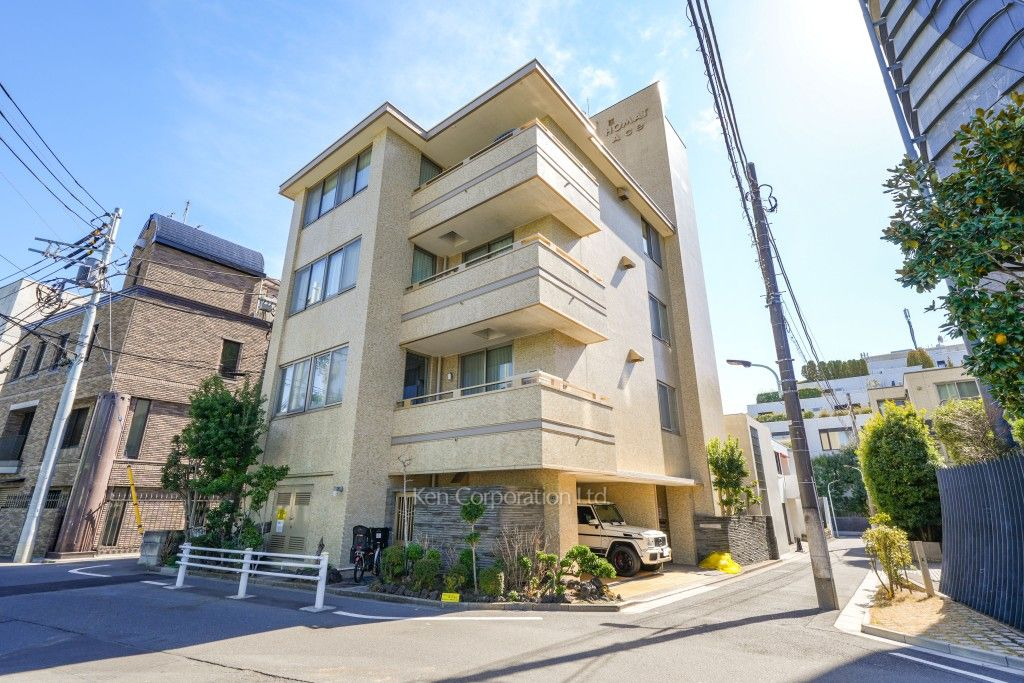
For comparison:
- Japan (national average): 38%
- New York City: 32%
- United Kingdom: 34%
In 2020, Tokyo’s average household size fell below 2.0, currently sitting at 1.84. Meaning that the average household in the Tokyo Metropolitan Area does not have 2 residents.
Other countries’ averages, according to their respective census data:
- Japan (national): 2.21
- United States: 2.60
- Canada: 2.46
- China: 2.80 (down from 3.44)
In some sense, this could be interpreted as the improving living standards and the financial independence of individuals who can now afford their own apartments rather than having to share, which is partly true. But in Japan, it also tells the tale of a growing loneliness pandemic, with the housing market enabling it by meeting the demand.
Table For One!
Tokyo might be one of the few places in on this green earth to have booths and seats for one in restaurants.
The most well-known example is Ichiran Ramen, one of the biggest ramen chains in Japan. Their special appeal is that you do not need to interact with a single person during your visit. You purchase a ticket from the machine, select your preferred ramen and soup consistency on a sheet of paper, and wait at a booth for a staff member to give you your bowl. Your booth is also surrounded by dividers, perfect for a solo diner!
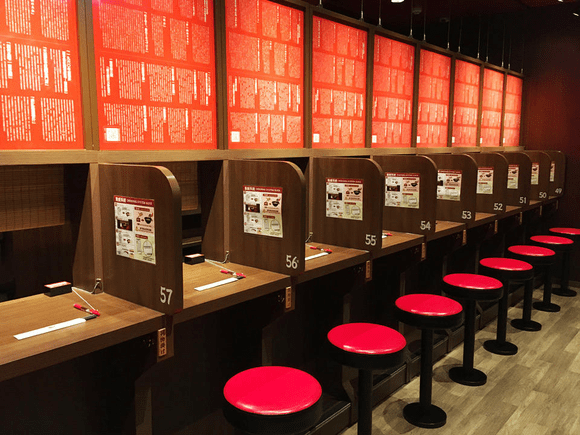
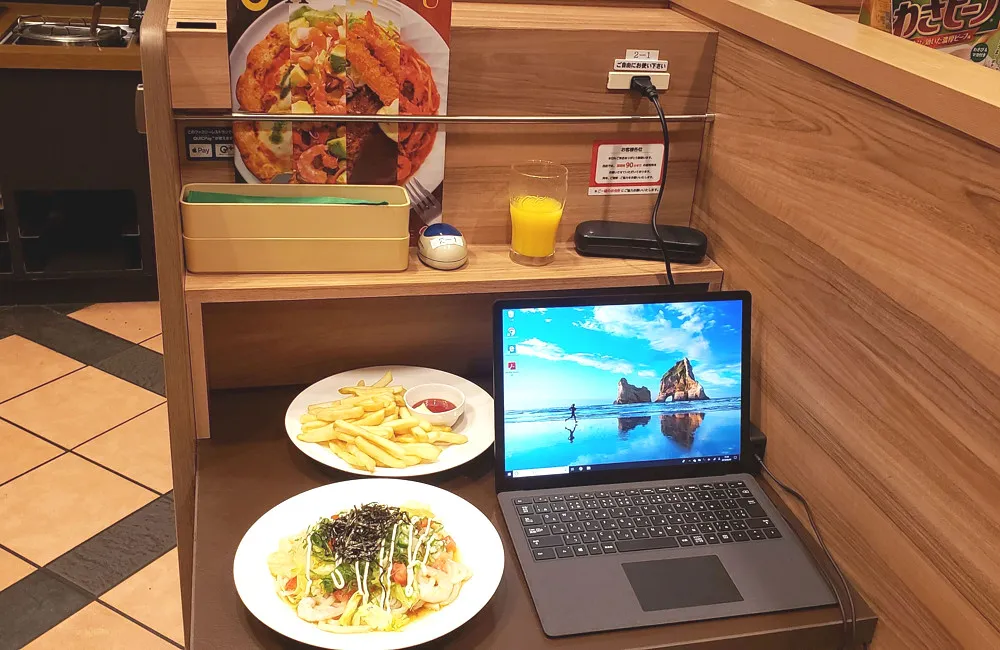
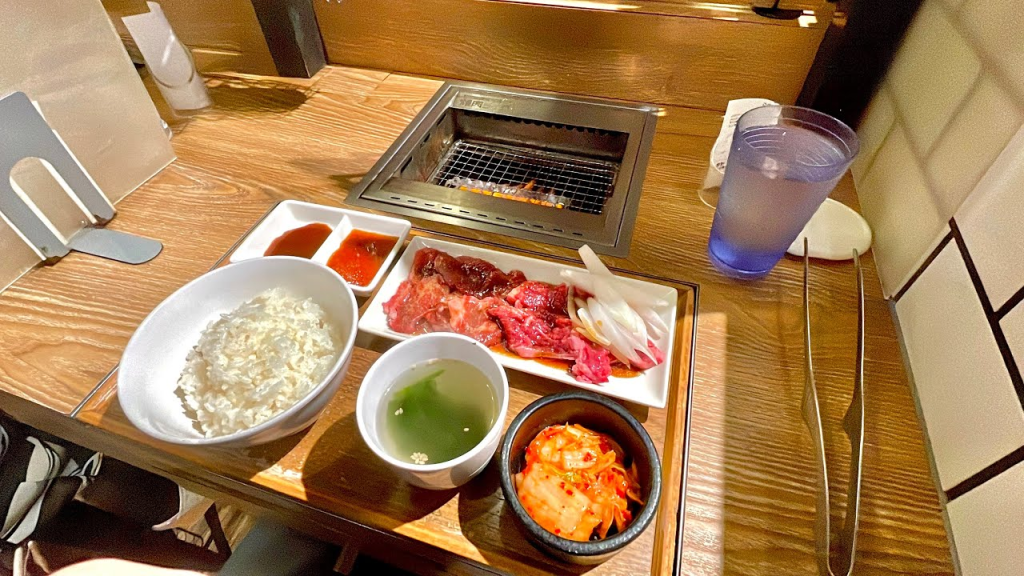
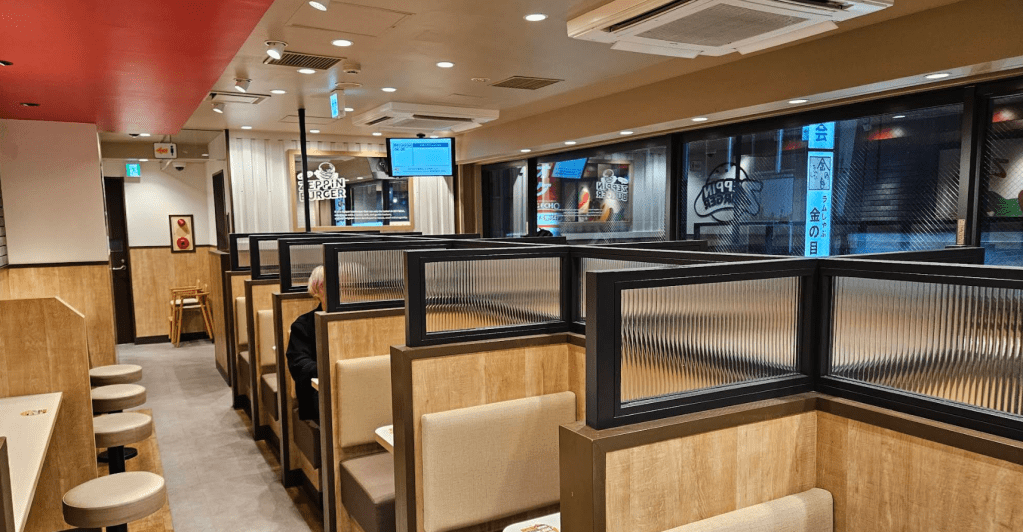
This unique and quirky dining experience is a hit among foreign visitors, but it’s a sign of the normalization of Japanese anti-social culture.
Train Station
Unless you take the Chuo, Yamanote, or Saikyo lines during the morning and evening rush hours, the public transit experience in Tokyo is generally pretty great. The fare price is affordable, the trains are fast, clean, and on-time. They are able to move massive amounts of people from place to place throughout Tokyo. The Tokyo train system has one of the highest riderships in the world. Out of the top 10 busiest train stations in the world, 9 of them are in Japan, and top 3 are all in Tokyo (Shinjuku, Shibuya, Ikebukuro). Japan has developed a efficiency system meant to accomodate this level of ridership with their limited space. The seamless integration of urban mass rapid transit trains, regional commuter lines, and cross country Shinkansen high-speed rail into the same station is just one of the many reasons to love about Japanese train systems.
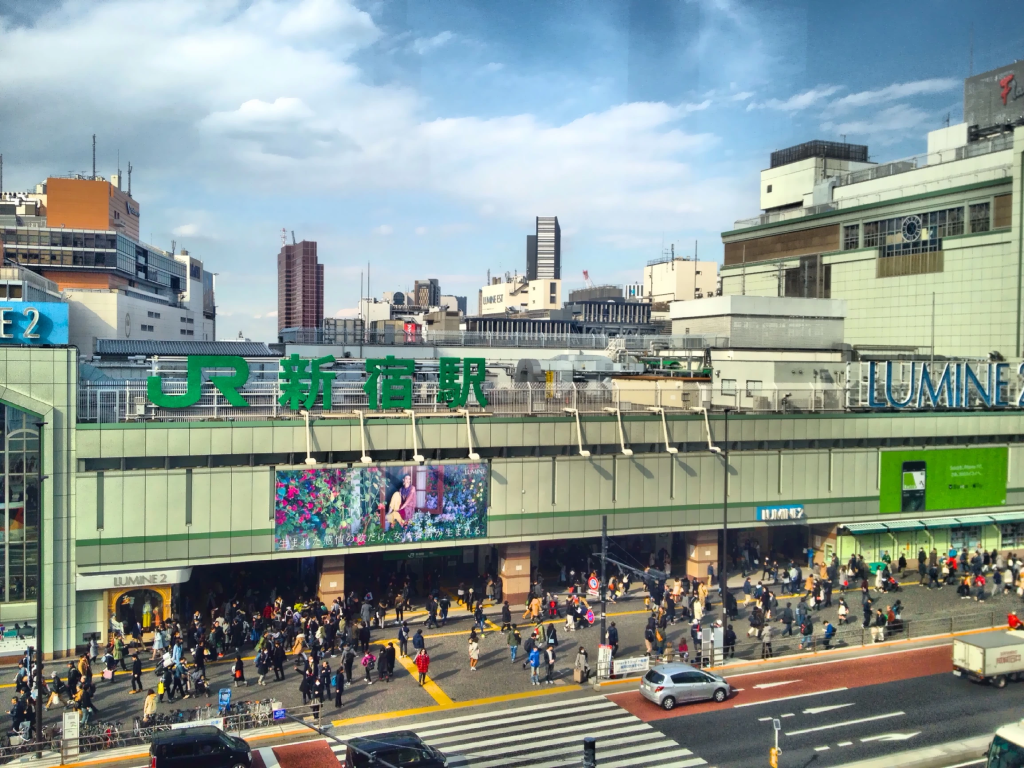
However, it is not perfect.
Butsukari Otoko
“Butsukari Otoko” (lit. “Bumping Man”) is a term used to describe people—typically working salarymen—who intentionally shoulder-check others in busy train stations. This is, as far as I’m concerned, a phenomenon unique to Tokyo.
These butsukari otoko are usually fed up and frustrated with their work and choose to take it out on strangers. The shoulder check is typically strong but subtle—strong enough to cause pain, but subtle enough to make it hard to prove. Nevertheless, there is no doubt that the act is intentional.
Their victims are usually women, as women tend to be less confrontational than men and make for easier targets. Victims are often left in shock, and by the time they recover and realize what happened, the cowardly perpetrator is already gone.
Butsukari otoko isn’t a common enough (unlike pickpockets in Rome) that would require you to be on edge every time you take the train in Tokyo, but it happens enough to have earned a name. It personally happened to me once, and to many friends I know. It’s a problem deeply rooted in misogyny, social pressure, and toxic work culture.
There are two other, more serious and darker issues that often take place on trains or in train stations, which I will discuss in “The Ugly” section. They make the “butsukari otoko” seem minor in comparison.
The Ugly
This section will discuss some of the most serious issues that plague Tokyo. Past the glamour and the neon lights, the dark side of the city lies where the lights don’t shine.
Sex-related Crimes
I sometimes joke about Tokyo being the “pervert capital” of the world, but that name carries a certain level of truth. The social isolation (loneliness pandemic), gender division (with society being highly gendered in every aspect), sexualization and dehumanization of women and young girls in media (just watch any anime), rampant misogyny (Japan ranks dead last in East and Southeast Asia with a Global Gender Gap Index of 0.663 in 2024), repressed emotions (people are taught from a young age to feel shame and not cause trouble), and the lack of repercussions for sex-related crimes all culminate in a variety of devious acts perpetrated against women and girls.
Chikan (“Train pervert”)
Some people may have heard of this, and yes—it is real. Trains in Tokyo can get very crowded, which creates opportunities for perverts to carry out their acts against women and girls traveling alone. I won’t go into detail about what they do, but it ranges from unwanted touching to sneaky upskirt photos. These acts are usually done in ways that allow plausible deniability if caught. Many of my female friends have experienced this, and it’s always highly traumatic, often causing lasting trust issues.
This is why women-only train cars exist and why phones in Japan have a built-in camera shutter noise that can’t be turned off.
Many stations and train cars also have signs reminding people that “Chikan” is illegal.
Stealing underwear
Yes, this is also a genuine concern. Women in Japan are advised to live on the 2nd floor of apartment complexes with locks to prevent this issue. When feminine clothing, especially undergarments are hung outside to dry (dryers are extremely rare in Japan), they face the risks of being stolen by perverts.
Stalking
Stalking exists everywhere in the world, and Japan is no exception. Although Tokyo’s reported figure for stalking is comparable with other major metropolitan areas, due to the cultural pressure to not report these incidents, the real figure is likely much higher.
Exploitation of young women
In the sex work, pornography, and idol industries, there are countless young women in Tokyo exploited for their sexual appeal. These are all massive industries that have an endless flow of consumers and the demand always exceeds the supply. Although governmental restrictions are in place, many of these companies continue to operate in a legal gray area.
Suicide
Japan is also infamous for its high suicide rate (16–17 per 100,000). While it is by no means the highest in the world—South Korea stands out with nearly double Japan’s rate at 28.6—it is still higher than the global average of around 10. Tokyo specifically had a rate of 17.1 in 2022, only slightly above the national average, indicating that this is not a problem unique to Tokyo.
Interestingly, Tokyo’s suicide rate for men is lower than the national average, while the rate for women is actually higher, which could be linked to the general treatment of women in Tokyo.
About 40% of male victims live alone, closely mirroring the statistic for single-occupancy apartments in Tokyo, highlighting social isolation as a key risk factor.
Suicide Rates (per 100,000) for comparison:
- Japan: 16.4 (2024)
- South Korea: 28.3 (2024) — highest in the OECD
- USA: 14.2 (2024)
- Canada: 11–12 (recent years)
- Australia: 12.0 (2021)
Why does this happen?
As mentioned before, social isolation is one of the biggest factors contributing to suicide. Tokyo is without a doubt one of the loneliest metropolitan areas in the world. The work culture, social culture, urban structure, and more make it incredibly difficult to form meaningful friendships. In a busy work environment, friendships become almost transactional. They require careful planning—often scheduling a month or two in advance to fit into two people’s packed schedules—and considerable effort after the initial meeting to gradually break down the tatemae.
Many people’s closest friends are old classmates from high school or university, especially if they were in the same club. Hobbies are a great way to connect people in their youth, but as adults, it also makes it harder to form emotional connections without a shared interest.
On the other side of the coin, another issue that plagues Japan—especially Tokyo—is the declining birth rate.
Birth Rate
People are generally aware of Japan’s infamously low birth rate, but how bad is it?
The replacement rate to maintain a population is 2.1, meaning 2.1 children per woman.
Japan’s national average was 1.20 in 2023, which is significantly lower than other developed nations (typically between 1.5 and 1.8). A declining birth rate is a normal trend as a nation’s economy matures—countries like the USA, Canada, and the UK have all experienced it, and China is starting to as well. However, Japan’s rate being this low indicates deeper issues.
Tokyo Prefecture’s birth rate is a shocking 0.99, the only prefecture below 1.0. Ironically, Tokyo is one of the few prefectures with a growing population, due to job prospects attracting migrants from all over the country. This means not only are Tokyo locals not having children, but Tokyo is also pulling down the country’s overall birth rate.
This low birth rate results in Japan having what is called an “aging population”, where the working-age group shrinks while the non-working senior population expands, putting more economic pressure on young people to subsidize the welfare seniors require. Japan’s diet and lifestyle are relatively healthy, and combined with a good healthcare system, seniors often live to very old ages.
Japan has the highest female life expectancy in the world at 87.14 years, and the 5th highest for men at 81.09 years. The global average in 2024 is 73.3 years.
In my view, Tokyo’s disastrously low birth rate is linked to many factors:
- The “loneliness pandemic”: As explained multiple times in this article, Tokyo is set up in a way that limits genuine human-to-human interactions, making it difficult for people to meet eligible partners.
- Work culture: Even if someone has a partner, the brutal and consuming work culture drains people of their time, energy, and—most importantly—optimism for the future.
- Cost of living: Let’s say a couple overcomes those barriers and wants to have a child. Raising a family in Tokyo is another story. Living in a single-occupancy apartment is out of the question, eliminating nearly half of all apartment units in Tokyo. Childcare requires time and effort, which is hard to find given work schedules. The alternatives are hiring a nanny—which is expensive and unpopular—or having one parent (usually the mother) quit their job to become a full-time stay-at-home parent. Raising a family on one income places a tremendous financial burden on the household.
- Lack of space: Even if a family meets all these requirements, Tokyo is still not a great place to raise children. It’s extremely crowded and everything is small. There aren’t many large spaces for kids to play and be active, except at school. Many parents opt to live in surrounding prefectures where there is more space, even if that means longer commutes to work.
Conclusion: What should we make of Tokyo?
I know I just spent the latter half of the post airing out Tokyo’s dirty laundry, but I truly enjoy living here. Most of what I just mentioned does not apply to me or any expat worker here. They are generally issues that have solutions or substitutes, but it’s their prevalence in Tokyo that speaks volumes about this metropolis’s general attitudes toward how life should be lived—something that I fundamentally disagree with.
The typical Tokyo salaryman lifestyle of waking up at 6 AM, getting to the office at 8 AM, leaving the office at 8 PM, drinking at an izakaya with your boss until 10 PM, falling asleep on the train until you get home, only to wake up in 6 hours to do it all over again, is not the way I want to live my life (I’m probably not alone on that).
Maybe some people find comfort in this type of routine and the allure of Tokyo is enough for them to tolerate it, but not me. I wouldn’t be able to handle this level of stress, and evidently, neither can most people here. It is extremely difficult to find a smiling face on a late-night train ride home, and I feel a mix of pity and appreciation for my own predicament.
Thanks to the JET Programme, my life in Tokyo is like a vacation. My job is incredibly easy. I get to come in and leave on time. The most “overtime” I have ever done was only an hour, and that was just me playing board games with my students. I even have enough time during “work hours” to complete hours and hours of writing (such as this one) and enough time between school semesters or long weekends to take trips to India, China, Taiwan, Kansai, Kyushu, etc.
I understand that my experience working in Tokyo is vastly different from a typical entry-level job here. My pay is higher and my work schedule is so relaxing it almost feels like part-time, but I suppose that’s why the JET Programme comes with a built-in expiry date of 5 years.
Anyway, I am extremely appreciative of my experience here and wouldn’t trade it for the world. Tokyo, even with its shortcomings, will always hold a special place in my heart as a place that enabled me to do things I never thought I could.
 David's Blog
Leave a comment